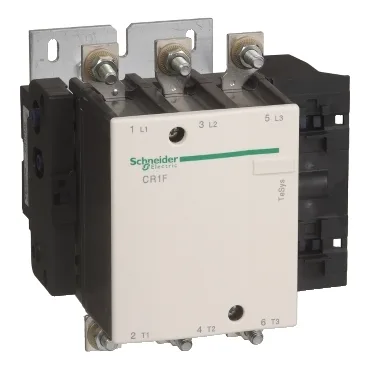
The magnetic latching mechanism holds the main poles closed without continuous coil power; it uses a 220 V DC control circuit, drawing 500 W to latch and 40 W to unlatch, with operating times of 45 to 50 ms for latching and 50 to 100 ms for unlatching. Rated insulation voltage is 1000 V per IEC 60947-4, with an impulse withstand voltage of 8 kV, so it's specified for 690 V line-to-line systems with adequate clearance. The conventional free air thermal current (Ith) is 350 A at 40 °C, which sets the continuous current-carrying capacity in an open panel — the AC-4 rating is the limiting factor for motor duty.
Motor power and application fit
Motor power ratings span 75 kW at 220–230 V up to 160 kW at 690 V AC, and 147 kW at 1000 V. For UL/CSA installations, it covers 60 hp at 200–208 V through 175 hp at 575–600 V. This is a large-frame contactor — the 8.4-inch depth and 7.9-inch width reflect the terminal hardware needed for cable lugs up to 240 mm² or bus bars. Tightening torque on the main connections is 35 N·m. Utilisation categories AC-1, AC-3, and AC-4 are all covered. AC-1 (resistive load) power dissipation is 39 W per pole; AC-3 (motor starting) drops to 22 W per pole. The rated breaking capacity at 220–440 V is 2450 A, and the rated short-time withstand current (Icw) is 2200 A for 1 second at 40 °C — enough to coordinate with upstream 315 A aM fuses or 400 A gG fuses.
The contactor is designed for panel mounting with lug or bar connections. Protective treatment is TH (tropicalized/humid environment). Maximum operating rate is 120 cycles per hour at 40 °C. No derating required up to 3000 m altitude.