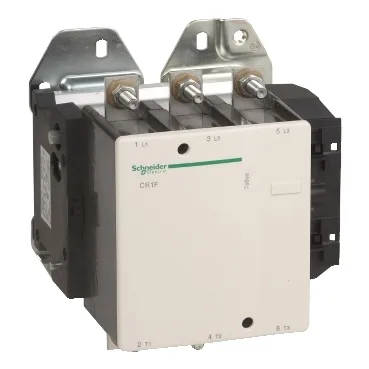
The Schneider Electric TeSys F CR1F500EZ7 is a 3-pole magnetic latching contactor rated for 500 A in AC-3 duty at 40 °C, with a 48 V DC low-consumption coil. It is designed for motor control and resistive load switching across utilisation categories AC-1, AC-3, and AC-4. The latching mechanism holds the main contacts closed without continuous coil power — the coil draws 550 W only during the 40–80 ms latching pulse, and 60 W during the 50–100 ms unlatching pulse, after which the coil is de-energised. This makes it suited for applications where sustained coil power is undesirable or where the contactor must stay closed through a control-power interruption.
The 500 A AC-3 rating governs motor switching — this is the current the contactor can make and break across a typical induction motor load. The AC-1 rating for resistive loads is higher at 700 A, and the AC-4 rating for inching/plugging duty is 460 A. The rated breaking capacity is 5000 A at 220–440 V, dropping to 2500 A at 1000 V, which tells you the maximum fault current the contactor can interrupt without damage. The rated short-time withstand current (Icw) is 4200 A for 1 second at 40 °C, so the contactor can hold through a downstream short-circuit until an upstream protective device clears. The rated insulation voltage (Ui) is 1000 V per IEC 60947-4, and the rated operational voltage (Ue) is 1000 V AC at 25–200 Hz.
Coil and control circuit specifics
The control circuit is DC low-consumption type at 48 V nominal. The coil operates reliably between 0.85 and 1.1 times Uc for both latching and unlatching. Average consumption is 550 W during the latching pulse and 60 W during unlatching — after the pulse, the coil draws nothing. This is a key difference from a standard contactor that must be continuously energised to stay closed. The operating time is 40–80 ms to close and 50–100 ms to open, which is typical for a large-frame contactor of this rating.
Physical integration and wiring
The contactor measures 232 mm deep, 233 mm wide, and 238 mm high — a substantial footprint that requires adequate enclosure space and clearance for cable bending. Power connections accept lugs or ring terminals up to 240 mm², or bars up to 40 x 5 mm. The tightening torque for main connections is 35 N.m. The associated fuse recommendation is 500 A aM or 800 A BS88/gG at up to 440 V. The protective treatment is TC (tropicalised coating), which adds corrosion resistance for humid environments.
Durability and thermal performance
The maximum operating rate is 120 cycles per hour at 40 °C. Power dissipation per pole is 45 W in AC-3 duty and 88 W in AC-1 duty — this heat must be considered in enclosure thermal calculations. The average impedance per pole is 0.18 mOhm at 700 A, 50 Hz, which gives a voltage drop of roughly 0.09 V per pole at rated current.