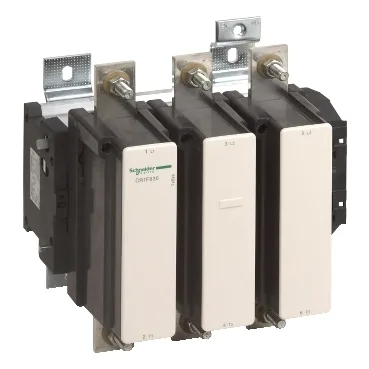
It's built for heavy motor and resistive load switching in control panels where maintaining contactor state without continuous coil power is critical. The latching mechanism holds position magnetically, so the coil only draws power during the 40...80 ms latching or 50...100 ms unlatching pulse, then drops to zero holding current.
Rated operational current (Ie) is 630 A at 1000 V in AC-4 duty — that's the severe switching category for plugging and inching of motors, not just running. In AC-3 (normal motor start/run) the same 630 A carries through. The conventional free-air thermal current (Ith) is 1000 A at 40 °C, which gives thermal headroom for busbar connections and continuous resistive loads. Motor power capability spans 450 kW at 690 V up to 800 hp at 575...600 V per UL/CSA — so it covers a wide range of large induction motors without needing to oversize. Rated breaking capacity hits 6300 A at 220...440 V, tapering to 3200 A at 1000 V. That's the fault it can interrupt without welding or failing. The rated short-time withstand current (Icw) is 5050 A for up to 10 seconds — enough to ride through downstream short-circuit clearing without the contactor itself tripping. Associated fuse rating is 630 A aM or gG, so coordination with upstream protection is straightforward. The 48 V DC low-consumption coil draws 620 W during the latching pulse and 45 W on unlatching — substantial for a few milliseconds, then zero. Control voltage limits are 0.85...1.1 Uc for both latching and unlatching, so a saggy 48 V bus at 40.8 V still picks it up. Rated insulation voltage (Ui) is 1000 V per IEC 60947-4, with impulse withstand (Uimp) at 8 kV. That means it's insulated for 1000 V line-to-line and survives surge events typical in industrial distribution.
This is a panel-mount contactor — no DIN rail clip. Terminals are busbars sized for two 60 x 5 mm bars per pole, tightened to 58 N·m. The enclosure cutout needs to clear 12.2 in (309 mm) width, 12.0 in (304 mm) height, and 10.04 in (255 mm) depth. It's TH protective-treated, meaning it's coated for tropical/humid environments — think textile mills, wastewater, or outdoor substations without climate control. Operating temperature range is -15 to 70 °C, storage down to -60 °C. Maximum operating rate is 120 cycles per hour at 40 °C — about one operation every 30 seconds. That's fine for motor starting duty; not for high-speed jogging or rapid cycling. Mechanical durability is 1 million cycles, which for a contactor this size is typical for a long service life in process applications.
Rated insulation voltage is certified to IEC 60947-4, IEC 60158-1, BS 775, and VDE 0110. The UL/CSA motor power ratings (800 hp at 575...600 V) confirm North American acceptance.