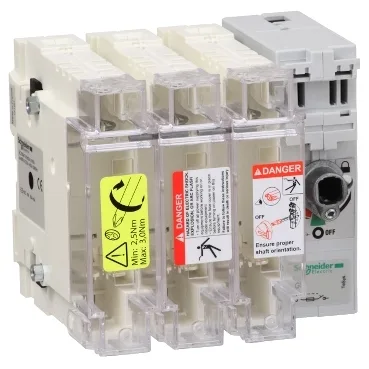
It's sized for DIN fuses, size 000, and rated to make and break motor and resistive loads under load. Rated operational current sits at 63 A for AC-23A and AC-23B duty across 400 V, 500 V, and 690 V, which covers the common motor-switching profiles in European and North American panel builds. Breaking capacity is 500 A at 400 V under AC-23B, so it can safely interrupt a stalled-rotor or short-circuit condition within that fault window. Rated operational power reaches 30 kW at 400 V, 40 kW at 500 V, and 55 kW at 690 V — meaning this one frame size covers a range of motor ratings depending on line voltage. The 3-pole, 3-NO contact arrangement makes it a straightforward fit for three-phase motor circuits.
Mounts to a plate (not DIN rail), so plan for a drilled backplate in the enclosure. The external operating handle can be mounted on the right side or the front of the enclosure door, which gives some flexibility for panel layout. Power-circuit connections accept lugs or ring terminals from 10 to 25 mm² — common for a 63 A feed. Tightening torque is 3.2 N·m on the power terminals, which is a standard value for this wire range. The fuse cover withstands 850 °C glow-wire test per IEC 60695-2-1; the body handles 960 °C — that's fire-resistance for a panel that might see a fuse fault.
The 63 A thermal current (Ith at 40 °C) sets the continuous-carry limit in free air — don't exceed that on a resistive load without derating for enclosure temperature. The AC-23B making capacity of 630 A at 400 V and breaking capacity of 500 A at 400 V tell you it can handle occasional switching of motor loads, not just infrequent isolation. Short-circuit withstand is 10.6 kA — that's the fault current the device can survive when protected by the correct upstream fuse. Rated insulation voltage is 750 V AC, impulse withstand 8 kV — that's standard for a 690 V rated switch-disconnector. No special clearance issues in a normal 400 V or 690 V panel.