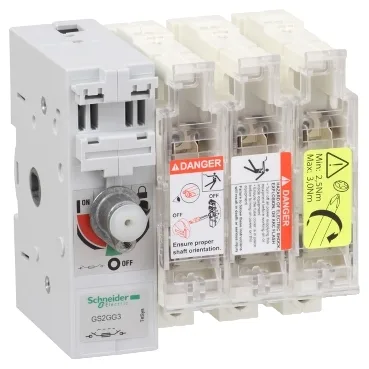
The TeSys GS GS2GG3 is a 3-pole switch-disconnector-fuse, rated for 63 A at 400 V AC in both AC-23A and AC-23B duty classes — meaning it handles motor switching (AC-23B) and general resistive/inductive loads (AC-23A) at that current. Breaking capacity sits at 500 A at 400 V (AC-23B), with a making capacity of 630 A at the same voltage — so it can close onto a faulted circuit and interrupt it without welding contacts. That's the kind of headroom you want in a feeder or motor branch circuit where fault current isn't trivial.
Mounts to a plate — no DIN rail clip here, so factor in the backplate drilling pattern. The external left-side operating handle means the switch sticks out to the left of the enclosure cutout; plan your door layout accordingly. Dimensions are 136 mm wide, 118 mm high, 116.5 mm deep — a compact footprint for a 63 A fused switch. Power circuit terminals accept lugs or ring terminals from 10 to 25 mm², torqued to 3.2 N·m. That's a solid connection range for the 63 A rating — fine for standard motor feeder cables.
The 63 A rating at 400 V AC-23B is the spec that decides fit for motor loads. At 690 V AC-23A/B it still carries 63 A — so it's usable across 400 V and 690 V systems without derating the current. Rated operational power is 30 kW at 400 V, 40 kW at 500 V, 55 kW at 690 V — that's the motor size it can switch at each voltage level. Short-circuit withstand is 10.6 kA, and the rated short-circuit making capacity hits 100 kA at 400 V when backed by gG fuses. That's a high-fault-capability device — it can handle a bolted fault downstream without blowing itself apart, as long as the upstream fuse coordinates. Rated insulation voltage is 750 V AC, impulse withstand 8 kV — solid margin for industrial 400/690 V networks. Mechanical durability is 10,000 cycles; electrical durability varies by duty: 1,500 cycles in AC-23A, 300 in AC-23B. If your application needs high-frequency switching, this isn't the part; it's a disconnect, not a contactor.