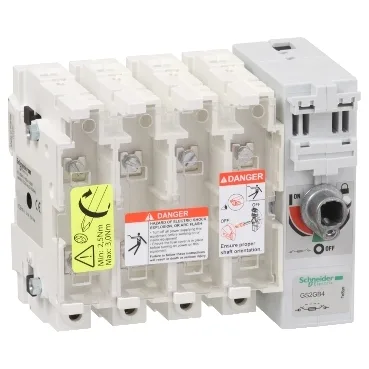
The GS2GB4 is a 4-pole switch-disconnector-fuse from the TeSys GS range, designed for fuse protection and isolation of motor and power circuits. For DC applications, the GS2GB4 is rated 40 A at 440 V with 2 poles in series per phase (DC-23A and DC-23B). The 4 NO contact configuration means all four poles are normally open, which is standard for a disconnector — you close them to energize the load, open them to isolate. The switch accepts BS-type fuses in sizes A2 and A3, so you're not locked into a single fuse format. It mounts to a plate (not DIN rail), so plan for screw-fixing in the panel layout.
This is a panel-mount device — plate mounting, no DIN-rail clip. The power circuit terminals accept lugs or ring terminals for 10 to 25 mm² conductors, torqued to 3.2 N·m. The external handle options (right side or frontal) give layout flexibility for enclosure doors or side panels. With IP20 protection (terminal cover fitted), it's suitable for inside a locked cabinet where accidental contact is prevented by the enclosure itself. The dimensions are 168 mm wide, 118 mm high, and 116.5 mm deep — factor that into your gland plate and busbar clearance. Rated operational power spans 30 kW at 400 V, 40 kW at 500 V, and 55 kW at 690 V — these are the motor sizes it can switch under AC-23A duty (frequent motor switching). For AC-23B (infrequent motor switching), the current rating is the same 63 A, but the electrical durability drops to 300 cycles versus 1500 for AC-23A — so if your application cycles the switch often, use the AC-23A column for life expectancy. Mechanical durability is 10,000 cycles, which is the handle and mechanism life before wear-out.
Rated to IEC 60947-3, the standard for switches, disconnectors, switch-disconnectors, and fuse-combination units. The insulation voltage (Ui) is 750 V AC, and the impulse withstand voltage (Uimp) is 8 kV — these define the clearance and creepage distances for safe installation in 400 V and 690 V systems. The short-circuit withstand is 10.6 kA, and with gG fuses the making capacity reaches 100 kA at 400 V — the fuse coordination limits the let-through energy. Fire resistance is tested: the fuse cover withstands 850 °C, the body 960 °C, per IEC 60695-2-1.