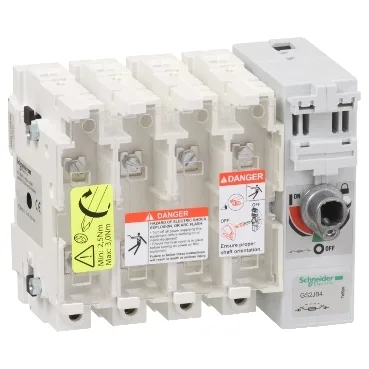
The Schneider Electric GS2JB4 is a TeSys GS switch-disconnector-fuse, a 4-pole unit rated for 100 A operational current across AC-23A and AC-23B duty classes at voltages up to 690 V.
Rated 100 A at 400 V AC-23A and AC-23B — that's the motor-switching duty class per IEC 60947-3, so it handles the high inrush of a motor start and the breaking of stalled-rotor current. For DC applications, it's rated 100 A at 440 V with two poles in series per phase (DC-23A/B), which is useful for battery banks or DC bus disconnects. Rated operational power spans 51 kW at 400 V up to 90 kW at 690 V, so it covers a wide motor horsepower range depending on your line voltage. The 8 kV rated impulse withstand voltage (Uimp) means it survives transient surges common in industrial environments without flashover. Mechanical durability is 10,000 cycles; electrical durability is 1,500 cycles under AC-23A/B. That's a maintenance interval to plan for — if your application cycles the disconnect daily, you'll want to track operations and schedule replacement before the contacts wear.
Plate-mounted, not DIN-rail — so you'll need a backplate or sub-panel with drilled holes matching the 162 mm height and 184 mm width footprint. The power circuit terminates via bars (up to 20 mm²) or ring-terminal lugs (25 to 95 mm²), torqued to 12 N.m. The external right-side or frontal operating handle gives flexibility for panel layout — you can mount the handle to match cabinet door cutouts or side-panel access. Four normally-open (NO) contacts confirm it's a straight disconnect, not a switched neutral or auxiliary contact block.