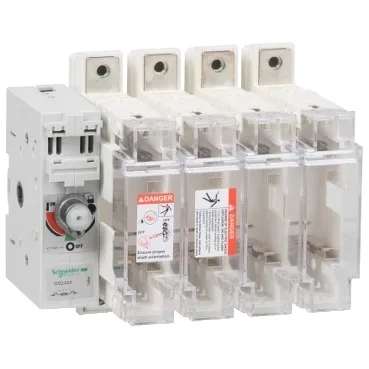
The Schneider Electric GS2JG4 is a TeSys GS switch-disconnector-fuse, a 4-pole unit rated for 100 A operational current across AC-23A and AC-23B duty classes at 400 V, 500 V, and 690 V. It uses NFC-type fuses in the 22x58 mm size, making it a straightforward fit for motor branch circuits or distribution panels where fused isolation is required. The making capacity is 1000 A at 400 V AC-23B, and the breaking capacity is 800 A at the same condition — these numbers govern its ability to close onto and interrupt faults under motor-starting duty. Rated operational power reaches 51 kW at 400 V, 63 kW at 500 V, and 90 kW at 690 V, so the same unit covers a range of motor sizes depending on line voltage.
The 100 A rating at 400 V AC-23B is the headline number — it tells you the switch can handle motor starting currents (typically 6-8x FLA) for that duty class. The impulse withstand voltage is 8 kV, which covers surge coordination for industrial panels. Mechanical durability is 10,000 cycles, and electrical durability varies: 1500 cycles under AC-23A and AC-23B at full rated current, and 300 cycles under the same conditions for the lower endurance figure. That's typical for a switch-disconnector — it's not a contactor meant for millions of operations, but it's robust for isolation and infrequent switching. Mounting is on a plate (not DIN rail), and the external left-side operating handle is included. Power circuit connections accept bars up to 20 mm² or ring-terminal lugs from 25 to 95 mm², with a tightening torque of 12 N.m.
The GS2JG4 is designed to IEC 60947-3, the standard for switches, disconnectors, switch-disconnectors, and fuse-combination units. The fire resistance rating is 850 °C for the fuse cover and 960 °C for the body, both tested to IEC 60695-2-1.