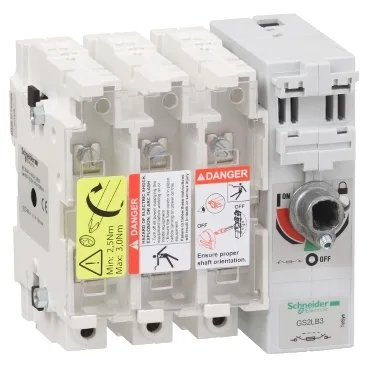
The Schneider Electric TeSys GS GS2LB3 is a 3-pole switch-disconnector-fuse rated 160 A conventional free-air thermal current (Ith) at 40 °C, accepting BS-type fuse links in sizes B1 and B2. It is designed for isolation and protection of power circuits per IEC 60947-3, with a making capacity of 1600 A and a breaking capacity of 1280 A at 400 V under AC-23B duty — the category for frequent switching of motor loads and other high-inductive circuits.
The headline rating is 160 A at 400 V AC-23A/AC-23B, which means it handles the high inrush of motor starting and the breaking of stalled-rotor currents within that category. At 690 V AC-23A/AC-23B the rating drops to 125 A — a derating to respect for 690 V applications. The rated operational power spans 80 kW at 400 V up to 110 kW at 500 V or 690 V, giving a direct motor-sizing reference. The short-circuit withstand is 20 kA, and with appropriate gG fuses the rated short-circuit making capacity reaches 80 kA at 400 V — meaning the switch can close onto a fault without welding its contacts, provided the upstream fuse clears the fault.
Mounts to a plate (not DIN rail), with power circuit terminals accepting bars up to 20 mm² or lugs/ring terminals from 50 to 95 mm². The tightening torque for power connections is 12 N·m. An external right-side or frontal operating handle is available.