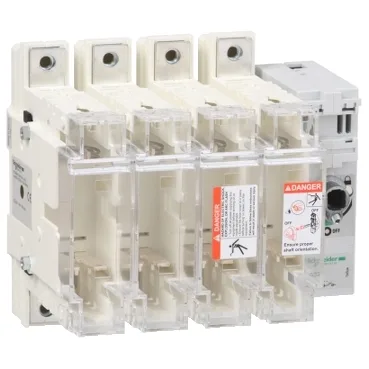
The GS2LL4 is a TeSys GS switch-disconnector-fuse — a 4-pole, 160 A device that combines a disconnect switch with fuse protection in one package. It's the component you spec when you need a visible-break isolation point with overcurrent protection built in, rated for motor and resistive loads under IEC 60947-3. Rated operational current hits 160 A at 400 V in AC-23A and AC-23B duty, which covers switching of motors and other highly inductive loads. At 690 V AC-23A/B it's rated 125 A. Making capacity is 1600 A at 400 V AC-23B; breaking capacity is 1280 A at the same condition.
Mounts on a plate (not DIN rail), with a DIN 00 fuse size. The 4-pole body takes up 184 mm width, 162 mm height, 126.5 mm depth — a compact footprint for a 160 A fused disconnect. Terminals accept power-circuit bars up to 20 mm² or ring lugs from 50 to 95 mm²; tightening torque is 12 N·m on the power circuit. IP20 with the terminal cover fitted — suitable for enclosure interiors where personnel access is restricted. The operating handle can be mounted externally on the front or right side, giving flexibility for panel layout.
The AC-23A and AC-23B ratings are the key selection parameters. AC-23A covers infrequent switching of motors and other highly inductive loads; AC-23B covers frequent switching. Both are rated at 160 A up to 500 V, derating to 125 A at 690 V. For DC applications, the device is rated 125 A at 440 V with two poles in series per phase — a common configuration for DC motor circuits or battery banks. Electrical durability is 1000 cycles for AC-23A/B, 200 cycles for DC-23A/B. Mechanical durability is 10,000 cycles — the switch mechanism itself outlasts the electrical contacts under heavy load. If your application cycles the disconnect under load frequently, factor in the electrical endurance limit. Rated operational power spans 80 kW at 400 V up to 110 kW at 500 V and 690 V. That's the motor power the device can switch at those voltages — useful for sizing against a specific motor nameplate.