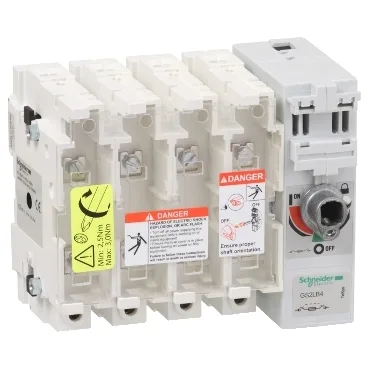
The Schneider Electric GS2LB4 is a TeSys GS switch-disconnector-fuse, a 4-pole unit rated for 160 A at 400 V AC-23B (the motor-switching duty class per IEC 60947-3). It accepts BS-type fuses in sizes B1 and B2, making it a direct line-side disconnect for motor feeders or distribution branches where fuse protection is specified.
The headline 160 A figure is the conventional free-air thermal current (Ith) at 40 °C, and the same 160 A appears across AC-23A and AC-23B duty at 400 V and 500 V — so it handles motor starting without derating at those voltages. At 690 V AC-23A/B the rating drops to 125 A, which is the value to check if your line runs at 690 V. Breaking capacity is 1280 A at 400 V AC-23B; making capacity is 1600 A at the same condition. Short-circuit withstand is 20 kA, and with gG fuse backup the rated short-circuit making capacity (Icm) reaches 80 kA at 400 V — meaning the fuse coordinates to let the switch survive a fault upstream. Rated operational power spans 80 kW at 400 V up to 110 kW at 500 V and 690 V, so it covers common European motor sizes in that band. The insulation voltage (Ui) is 750 V AC, impulse withstand (Uimp) is 8 kV — standard for industrial panel distribution.
Mounts to a plate (not DIN rail), with the operating handle configurable for external frontal or external right-side operation — useful when the switch sits deep in a panel and the handle needs to reach through the door. Power circuit terminals accept bars up to 20 mm² or ring lugs from 50 to 95 mm²; tightening torque is 12 N·m. IP20 with the terminal cover fitted, so it's protected against finger contact inside the enclosure but not for wet environments.