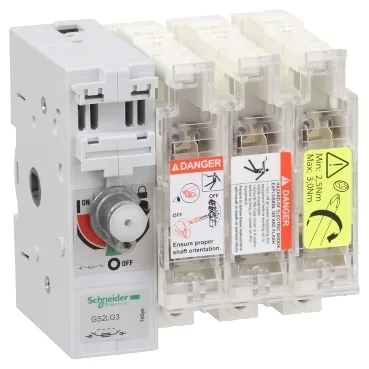
The GS2LG3 is a 3-pole switch-disconnector-fuse from the TeSys GS range, designed for DIN fuse size 0. It's the part you spec when you need a fused disconnect that meets IEC 60947-3 for isolation and switching duty — not a contactor for frequent cycling, but a manual disconnect with a visible break for safe maintenance lockout. Rated operational current hits 160 A at 400 V AC-23A/AC-23B, and 125 A at 690 V in the same AC duties. For DC applications, it carries 125 A at 440 V with two poles in series per phase (DC-23A/DC-23B). Breaking capacity is 1280 A at 400 V AC-23B; making capacity is 1600 A at the same voltage and duty. Short-circuit withstand is 20 kA, and with gG fuses protecting it, the rated short-circuit making capacity jumps to 80 kA at 400 V. That's the number your panel designer needs for SCCR coordination downstream.
Mounts on a plate — not DIN rail — so plan for a drilled backplate or a sub-panel. Dimensions are 190 mm wide, 162 mm high, 136.5 mm deep. Power circuit connections accept bars up to 20 mm² or ring terminals from 50 to 95 mm². Tightening torque on the power terminals is 12 N·m. IP20 with the terminal cover fitted, per IEC 60529. The external left-side operating handle means the switch sticks out the left face of the assembly; factor that into your panel layout and door cutout.
Electrical durability is rated at 1000 cycles for AC-23A/AC-23B and 200 cycles for DC-23A/DC-23B. Mechanical durability is 10,000 cycles. That's not a high-cycle switching device — it's a disconnect for infrequent manual operation, typically for isolation and short-circuit protection of a motor branch circuit.
Operates from -20 to 70 °C ambient; stores from -40 to 80 °C. Rated insulation voltage is 750 V AC, with an impulse withstand voltage of 8 kV.