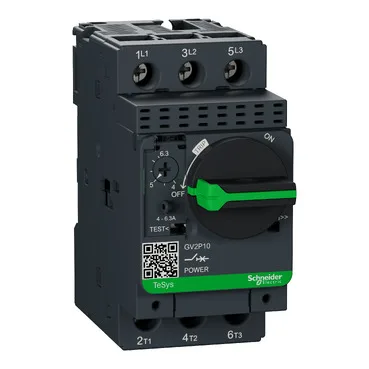
The headline number here is the breaking capacity: 100 kA Icu at 400/415 V AC. Motor power ratings are 2.2 kW at 400/415 V, 3 kW at 500 V, and 4 kW at 690 V — all at 50/60 Hz.
The 45×89×97 mm footprint is standard for the TeSys Deca family, so swapping into an existing GV2 cutout is a direct mechanical fit. Power connections accept up to 6 mm² solid or 4 mm² flexible with ferrules; torque the screw clamps to 1.7 N·m. IP20 finger-safe terminals and IK04 impact resistance mean it's protected against accidental contact and light mechanical shock inside a closed panel. Not rated for washdown environments — this is a dry-side component.
Certifications cover the major industrial markets: EN/IEC 60947-2 and -4-1 for Europe, UL 60947-4-1 for North America, CSA C22.2 No 60947-4-1 for Canada. Also listed for IEC/EN 60335 appliance standards if your machine ends up in a white-goods or HVAC line. These approvals are on the nameplate — no separate documentation chase.
The 6.3 A thermal setting protects a motor drawing roughly 2.2 kW at 400 V — typical for a small conveyor, pump, or fan. The thermal-magnetic curve is fixed (no interchangeable trip blocks), so you pick the exact GV2P variant by motor FLA. Phase failure sensitivity is built in per IEC 60947-4-1, meaning it trips on single-phasing without an external relay. Electrical durability is 100,000 cycles at rated current in AC-3 duty — that's switching motor loads on and off, not just resistive loads. Mechanical durability matches at 100,000 cycles. For a motor starter that cycles several times per shift, that's years of service before contact wear becomes a concern. Power dissipation per pole is 2.5 W, so total heat in the enclosure is about 7.5 W at full load. In a dense panel with multiple breakers, that matters for thermal derating — keep ambient below 40 °C for full rated current.