Speed-torque envelope on 24 V versus 48 V bus
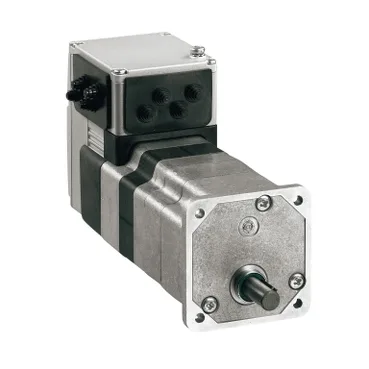
The ILE2P662PC1A0 is a brushless DC servo from the Lexium integrated drive line (device short name ILE), and the speed-torque envelope changes meaningfully with the DC bus you feed it: nominal torque is 0.5 N·m at both 24 V and 48 V, but nominal speed is 3100 rpm on 24 V and 5000 rpm on 48 V, with peak stall torque reaching 0.8 N·m at either rail — so the choice of 24 V versus 48 V is a speed decision, not a torque decision. Continuous output power scales with that same bus choice: 162 W at 24 V versus 262 W at 48 V, so a panel wired for 48 V delivers the same torque at roughly 1.6× the mechanical power before current limits kick in.
Current draw, protection, and what the integrated drive actually does
This is a DC-bus integrated drive (network type DC, single-phase supply), not a mains-fed VFD — the drive electronics sit on the motor, so peak current consumption is 7000 mA and maximum continuous is 5500 mA, and the integrated protection covers safe torque off, output short circuit, and output overload, meaning the STO input is built in rather than added by an external safety relay. The motor flange is 66 mm (2.6 in) with a 25 mm shaft at 8 mm diameter, untaped and without a second shaft end or holding brake — a flange-mount package aimed at compact motion axes where the brake and gearbox are handled separately, if needed. Winding is the medium-speed / medium-torque variant; feedback is a BLDC encoder with ±0.5° accuracy and 0.106 N·m detent torque — the encoder is integral, so position control closes on the motor body without an external feedback cable run.
Wiring, I/O, and field-side connections
The drive exposes 4 signals, each usable as either input or output, over an industrial connector with a 100 Mbit transmission rate — modest I/O count for a small axis, with fieldbus handled on that same connector rather than a separate port block. Mechanical mounting is flange-style with a 2 mm centring collar, and the unit cools by natural convection — no fan, no forced-air clearance budget, which matters in a sealed cabinet where a 24 VDC bus is already being switched at the head end. The unit is rated for 150 m/s² shock (1000 shocks) and 20 m/s² vibration over 10–500 Hz per EN/IEC 60068-2-6/29, operating up to 1000 m altitude without derating and 15–85 % non-condensing humidity — values consistent with a panel-mounted axis on a moving machine rather than a fixed outdoor site.
Compliance and what the standards list actually covers
The standards line on this part covers EN 61800-3:2001 (EMC for power drive systems, second environment), EN 50347 (small-power motors, standardised dimensions), IEC 60072-1 (motor frame designation), and EN/IEC 50178 (power electronic equipment for power installations), with CE marking — together this is a drive-class EMC profile plus industrial-frame motor compliance, not an ATEX or food-grade certification.