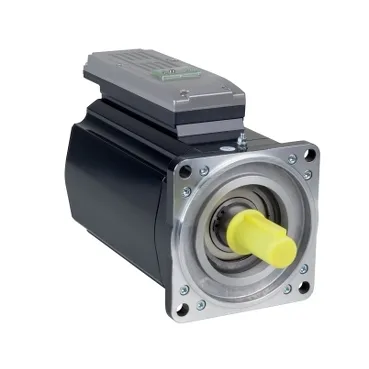
Package and what it bolts into
The Schneider Electric ILM1401P22F0000 is an ILM-series integrated-drive servo motor in the PacDrive 3 range: 140 mm flange on an international standard flange mount, 292 mm body length, 24 mm untapped shaft with a 50 mm engagement and a 40 mm keyway, with no second shaft end. Cooling is natural convection, not forced air, so the cabinet or machine envelope has to carry the motor's dissipated heat without starving it of free airflow around the fins. IP65 means the housing keeps dust and water-jet spray out of the internals — the motor can sit just outside a washdown cabinet door or near a process splash zone rather than behind a fully sealed panel.
Torque, speed, and current envelope
Nominal output is 1450 W with 4.6 N.m of continuous torque at 3000 rpm — sized for mid-range conveyor, indexing table, and pick-and-place axes in packaging and material-handling lines. Peak stall torque reaches 27 N.m for short accelerations, roughly six times the continuous figure, which sets how aggressively the axis can be profiled before the drive trips on the Irms ceiling. Line current is 2.9 A nominal and 4.7 A continuous stall, with a maximum Irms of 18.8 A for the overload window — the drive sizing and branch-circuit protection downstream have to clear that peak without nuisance trips during fast moves. Holding brake torque is 18 N.m and continuous stall torque sits at 7.5 N.m — the brake is sized to hold the vertical axis at standstill, not to stop a moving load, so an external dynamic-stop resistor or counter-EMF braking scheme is needed for emergency-stop energy.
Rotor inertia, feedback, and drive loop
Feedback is absolute multiturn SinCos Hiperface, so the axis comes up with absolute position on power-up and the drive closes the current loop on a high-resolution sine/cosine signal — no homing run needed after every power cycle. The motor constants — Kt 1.6 N.m/A and back-EMF 108 V/krpm at 20 °C — are what the drive uses to set the current-loop gain and the field-weakening limit; the published stator resistance (1.81 Ω phase-to-phase at 20 °C, dropping to 1.26 Ω phase-to-neutral at 120 °C) is the figure that drives copper-loss budgeting at the rated torque point.
Shaft load limits across the speed range
Maximum radial force Fr is 2210 N at 1000 rpm, 1760 N at 2000 rpm, and 1530 N at 3000 rpm — the bearing life curve, not the torque curve, drives coupling and pulley selection at the high end of the speed band. Maximum axial force Fa is capped at 0.2×Fr, which limits how much thrust a leadscrew or gearbox can load back onto the motor front bearing without a separate thrust-rod arrangement.
Lifecycle and sourcing posture
PacDrive 3 ILM integrated-drive motors are specified to order against the BOM: each unit carries the holding-brake option, the feedback protocol, and the flange size that the project drawing calls out, so the procurement line is confirmed against an RFQ rather than pulled from a generic shelf.