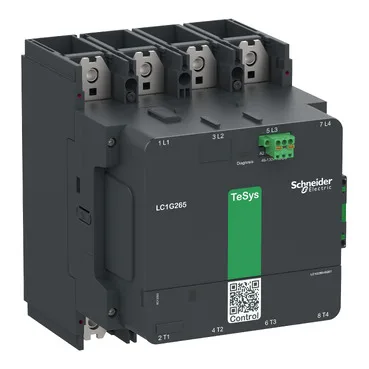
The LC1G4004EHES207N is a 4-pole TeSys Giga contactor rated for 200 kW at 400 V AC-3e — that is the motor-switching duty class that governs real-world induction motor starts and stops. The AC-3e rating, not the higher AC-1 resistive current, is the one that decides whether this contactor holds in on a compressor or conveyor drive. At 460/480 V 60 Hz it handles 300 hp, and at 575/600 V 60 Hz it handles 400 hp, which covers most North American medium-voltage motor frames in a single device. The control circuit accepts 48-130 V AC or DC, with a built-in bidirectional peak-limiting coil that suppresses the inductive kick on dropout. That means no external varistor or RC snubber needed across the coil terminals — one less component to source and mount on the panel rail. Rated insulation voltage is 1000 V, and the contactor carries overvoltage category III, so it is suited for fixed-installation distribution panels where transient overvoltages from the supply side are expected.
Deployment context
This contactor mounts on a plate — not a DIN rail — so plan for a drilled backplate in the enclosure. The power circuit uses bolted connections: bar or busbar up to 32 x 10 mm, or lugs up to 185 mm². Tightening torque on the main connections is 35 N·m, which requires a torque wrench during panel assembly. The 225 mm cube footprint (225 x 140 x 225 mm) and 45 mm pole pitch mean it occupies a significant chunk of backplate real estate — factor that into gland-plate planning and cable bend radius for the 185 mm² power conductors.
Compliance documentation is extensive: the contactor is certified to EN/IEC 60947-4-1 (contactor standard), EN/IEC 60947-5-1 (control circuit devices), UL 60947-4-1, CSA C22.2 No 60947-4-1, JIS C8201-4-1, and JIS C8201-5-1. It also carries UL 60335-1 and UL 60335-2-40 Annex JJ for household and HVAC appliance applications. The TH protective treatment indicates it is suitable for tropical/humid environments.
Safety and durability
The safety reliability figures (B10d = 400,000 cycles at nominal load, 3,000,000 cycles at mechanical load per EN/ISO 13849-1) mean it can be used in safety-related control circuits where the contactor is part of the stopping chain. Vibration resistance is 2 gn (contact open) and 4 gn (contact closed) across 5-300 Hz, with shock resistance of 10 gn (open) and 15 gn (closed) at 11 ms. That is sufficient for most industrial environments including near large rotating machinery.