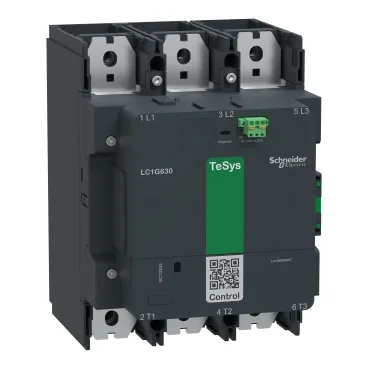
The Schneider Electric TeSys Giga LC1G6304EHES207N is a 4-pole power contactor built for heavy motor switching and general power control. Its headline rating is 315 kW at 400 V AC in AC-3e duty — that is the motor-switching category with enhanced electrical endurance, so it handles the inrush and breaking of squirrel-cage motors up to that power level without derating. The 48-130 V AC/DC control coil is a wide-range type, meaning it accepts either supply without a separate rectifier or voltage adapter, simplifying panel wiring. The contactor is rated for AC-1, AC-3, AC-3e, AC-4, DC-1, DC-3, and DC-5 utilisation categories. Breaking capacity is 5550 A at 440 V; making capacity is 7220 A at 440 V.
This is a plate-mount contactor — dimensions are 509 mm high, 302 mm wide, 355 mm deep. The power circuit uses bolted connections or busbars up to 52 x 20 mm cross-section; lugs and ring terminals up to 185 mm² are also supported. The 70 mm connection pitch between poles is generous, allowing large cable lugs or busbar work without crowding. The front face carries IP2X protection with shrouds fitted, which is finger-safe per IEC 60529 and VDE 0106. That matters when the contactor sits in an open panel during commissioning — no additional guarding needed for accidental touch. The TH protective treatment means it is coated for tropical/humid environments, so condensation in an unheated enclosure is less of a corrosion risk.
The mechanical durability is 5 million cycles — that is the expected life of the contactor's mechanical mechanism under no-load or light-load conditions. The maximum operating rate is 500 cycles per hour in AC-3 and AC-3e, and 150 cycles per hour in AC-4. If your application involves frequent jogging or plug reversing (AC-4), the operating rate drops, so plan your duty cycle accordingly. The power dissipation per pole is 70 W at AC-1 rated current (1050 A) and 26 W at AC-3 rated current (630 A) — this heat must be considered in enclosure sizing, especially if multiple contactors are ganged. The contactor carries a B10d safety reliability rating of 100,000 cycles under nominal load and 1,800,000 cycles under mechanical load per EN/ISO 13849-1. That is a statistical measure of the number of cycles until 10% of the population fails dangerously — useful when calculating the safety integrity level (SIL) or performance level (PL) of a safety circuit that includes this contactor.