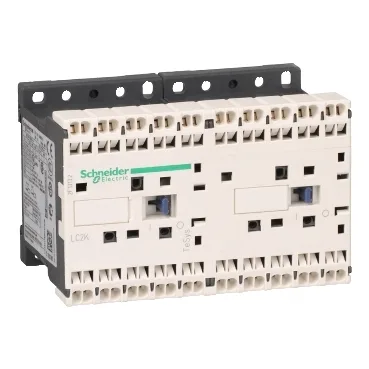
Rated AC-3 at 12 A up to 440 V and AC-1 for resistive loads, it handles typical small motor reversing duties on pumps, conveyors, or fans. The coil pulls in at 100 V AC, and the 1 NC auxiliary gives you a feedback or status contact for the controls side.
The AC-4 rating covers plugging and inching duty, where the contactor breaks the motor at full locked-rotor current — if your application does frequent reversing under load, that's the rating to watch. The 690 V AC rated operational voltage on the power circuit means it can also serve in 480 V or 575 V systems, but the AC-3 current will derate above 440 V; the datasheet curve (not reproduced here) governs that.
Mechanical and environmental toughness
This contactor handles 10 to 15 Gn shock on the X, Y, and Z axes with the contacts closed, and 6 to 10 Gn when open — numbers that matter if the panel is mounted on a vibrating machine or near a press. Vibration resistance is 4 Gn closed, 2 Gn open, over 5 to 300 Hz. It's rated for operation up to 2000 m altitude without derating, so high-altitude plants are fine. Flame retardance meets UL 94 V1 and NF F 16-101/102, which is a plus for rail or transit applications where fire safety is a spec line.