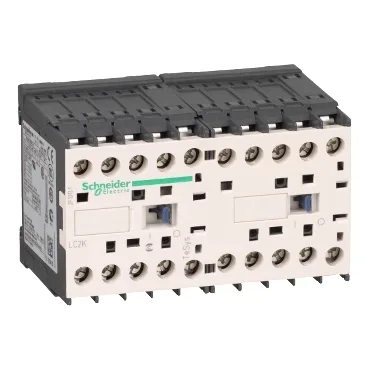
The 380…400 V AC coil pulls in across that voltage band, and the contactor is rated for AC-3 duty at 12 A up to 440 V, meaning it switches three-phase squirrel-cage motors on and off under load within that current envelope. It also carries AC-4 ratings for plugging and inching, and AC-1 for resistive loads.
The AC-3 12 A rating at ≤440 V is the headline motor-switching figure — it governs the maximum full-load current of the motor you can reverse with this contactor. For a 400 V three-phase induction motor, 12 A AC-3 corresponds roughly to a 5.5 kW output, though you should verify locked-rotor current and duty cycle against the AC-4 curve if the application involves frequent reversing under load. The coil is wound for 380…400 V AC 50/60 Hz, so it drops straight into a European 400 V line without a control transformer. Flame retardance meets V1 per UL 94 and NF F 16-101/102, which is relevant for rail and transport applications. The preassembled reversing busbar saves installation time compared to building a reversing pair from two individual contactors plus a mechanical interlock.
Mechanical robustness for industrial environments
The contactor is rated for shock and vibration per IEC 60068-2-27 and IEC 60068-2-6. With the contactor closed, it withstands 10 Gn on X axis and 15 Gn on Y and Z axes for 11 ms; open, it handles 6 Gn on X and 10 Gn on Y and Z. Vibration resistance is 4 Gn closed and 2 Gn open across 5…300 Hz. These figures matter for applications mounted on machinery or in mobile equipment where mechanical shock is a risk.