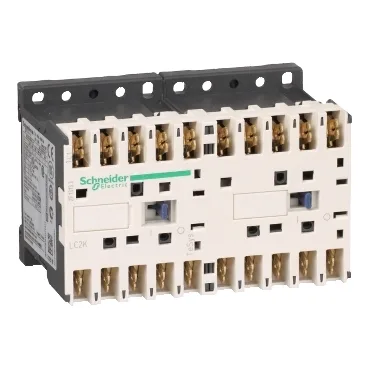
What this reversing contactor delivers
Rated AC-3 at 16 A up to 440 V, it handles the forward/reverse switching of a three-phase motor in that current class. The 660-690 V AC coil means it pulls in on a 690 V control circuit, common in European 400/690 V distribution where the line-to-line voltage supplies the coil directly. This is a control-circuit device, not a power-switching contactor for resistive loads. The AC-3 category tells you it's designed for starting and stopping squirrel-cage motors — making and breaking the motor's locked-rotor current, which is typically 6-8x the full-load current. At 16 A AC-3, it's sized for motors drawing about 7.5 kW at 400 V three-phase.
Because this is an active part with no announced successor, there is no cross-reference to a newer order code. The LC2K prefix is the reversing contactor variant within TeSys K; the straight (non-reversing) version carries the LC1K prefix if that's what your BOM actually calls for.
The IP20 finger-safe housing means it can be mounted in an open panel without additional shrouding, though the power terminals still require a screwdriver for the cage-clamp connections. The preassembled reversing busbar saves about 10 minutes of wiring per unit on the line.
Mechanical and environmental robustness
The contactor is rated for shock and vibration per IEC 60068-2-27 and IEC 60068-2-6. With the contactor closed, it withstands 10 Gn on the X axis and 15 Gn on Y and Z axes for 11 ms shocks. Vibration resistance is 4 Gn from 5 to 300 Hz when closed, 2 Gn when open. That's enough for most industrial machinery, including conveyors, pumps, and compressors mounted near the driven load. Protective treatment conforms to IEC 60068 and DIN 50016 — a tropicalization coating that resists humidity and condensation. Not a washdown rating (IP20 only), so keep it inside the enclosure, not on the machine frame exposed to coolant spray.