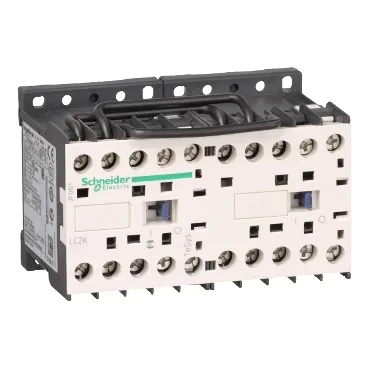
It is a 3-pole (3P) unit rated for AC-3 duty at 16 A up to 440 V, meaning it can reliably switch a 3-phase induction motor on and off under load — the AC-3 category specifically covers starting and stopping squirrel-cage motors, which is the standard for most conveyor, pump, and fan circuits. The reversing configuration is built in with a preassembled reversing power busbar, so you get forward/reverse interlocking without extra wiring or a separate mechanical interlock kit. The coil is 12 V AC, which locks out any 24 V or 120 V control schemes — verify your control transformer taps before wiring. The signalling circuit contact is rated at 10 MOhm, which is the insulation resistance, not a switching current — that means the auxiliary NO contact is suitable for low-energy PLC or relay inputs, not for powering a load directly. IP20 protection means it is finger-safe but not protected against moisture or dust ingress — it belongs inside a control cabinet, not on the machine frame in a washdown area. The enclosure must provide the environmental seal.
Mechanical fit and mounting
That footprint is compact for a reversing contactor with integrated busbar — it occupies roughly the same panel space as two standard TeSys K contactors side by side, but the preassembled reversing bar eliminates the need for the inter-busbar jumper and reduces wiring time. Mounting is via the standard DIN-rail clip (35 mm symmetrical rail per IEC/EN 60715). The unit is preassembled with the reversing power busbar, so the two contactors are mechanically interlocked and the power circuit is already jumpered for reversing. This saves about 15–20 minutes of panel wiring per reversing starter and eliminates a common error point where the interlock is misaligned or the busbar is torqued unevenly.
The TeSys K range is a long-running series with broad installed base, so spares support and documentation are readily available. If you are freezing a BOM for a new panel design, this part is a safe choice for the production run.