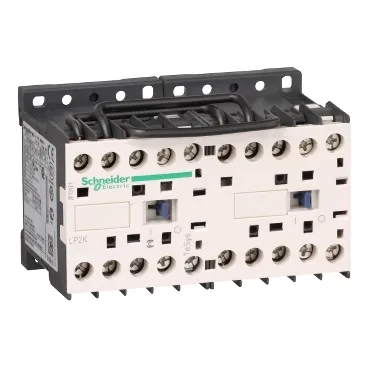
Rated 20 A in AC-1 utilisation category (resistive load), it handles switching of heaters, lighting banks, or transformer primaries. The 4-pole configuration gives you three power poles plus one auxiliary, or four independent power paths, depending on the wiring scheme. Rated breaking capacity reaches 110 A at 440 V, 80 A at 500 V, and 70 A at 660–690 V — meaning it can interrupt fault currents well above its continuous rating, which matters for coordination with upstream protection.
The 12 V DC coil includes a built-in bidirectional peak-limiting diode suppressor, so you do not need an external flyback diode across the coil terminals. Pick-up time is 30–40 ms; drop-out is 10 ms for the NO opening. Coil operates between 0.8 and 1.15 Uc (9.6–13.8 V DC) and drops out between 0.1 and 0.75 Uc (1.2–9 V DC) below 50 °C. Inrush power is 3 W at 20 °C; steady-state heat dissipation is also 3 W.
Mounts on rail or plate — the 90 mm width and 58 mm height fit standard panel layouts. Screw-clamp terminals accept 1.5–4 mm² solid or 0.75–4 mm² flexible (without ferrule), or 0.34–2.5 mm² flexible with ferrule. Tighten to 1.3 N·m with a #2 Philips or 6 mm flathead. The mechanical interlock prevents both contactors in a reversing pair from closing simultaneously — a standard safety feature for motor-direction control.
Designed to IEC 60947-4-1, UL 508, and CSA C22.2 No 14, with rated insulation voltage of 690 V (IEC) and 600 V (UL/CSA). Also complies with BS 5424, NF C 63-110, and VDE 0660. Flame retardance is V1 per UL 94. Safety reliability: B10d of 1,369,863 cycles at nominal load and 20,000,000 cycles at mechanical load per EN/ISO 13849-1 — relevant if the contactor is used in a safety-related control system.