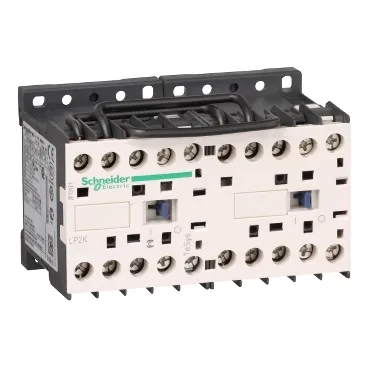
It's rated for AC-1 resistive loads, meaning it's sized for heater banks, lighting, or transformer primary switching — not for motor starting under load (that's AC-3 duty). The coil pulls 36 V DC, with a built-in bidirectional peak limiting diode suppressor that handles the inductive kickback, so you don't need an external flyback diode across the coil terminals.
The AC-1 thermal current (Ith) is 20 A at 50 Hz, with an average power circuit impedance of 3 mOhm — that's the continuous current the main poles can carry in a resistive circuit. Rated breaking capacity is 110 A at 440 V, 80 A at 500 V, and 70 A at 660–690 V per IEC 60947 — these are the fault-clearing numbers for the contactor's own poles, not the upstream protection. Associated fuse recommendation is 25 A gG or 25 A aM for the power circuit; that's the max fuse size to coordinate with the contactor's withstand. Mechanical durability is 5 million cycles, electrical durability is 300,000 cycles at 20 A AC-1 at up to 440 V — the mechanical figure is the one that governs in low-current or dry switching applications. Coil operating limits are 0.8 to 1.15 times Uc (29 to 41 V DC) for pick-up, and drop-out between 0.1 and 0.75 Uc (3.6 to 27 V DC) — so a 24 V DC control bus that sags below 29 V during a brownout may fail to close this contactor.
Mounts on a plate or DIN rail — the 90 mm width, 58 mm height, and 57 mm depth fit a standard panel layout, and the screw-clamp terminals accept 0.34 to 4 mm² solid or stranded wire, with a tightening torque of 1.3 Nm using a No. 2 Philips or 6 mm flat screwdriver. The mechanical interlock between the two contactor halves is built in — no external linkage to add, and the reversing busbar is already fitted, so this is a drop-in replacement for a reversing starter or transfer-switch circuit.