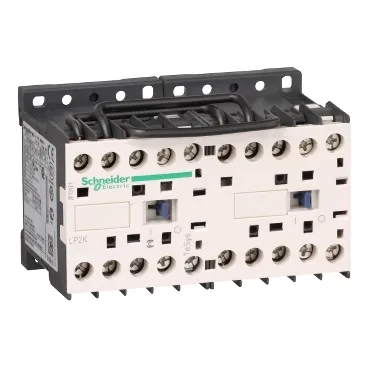
It's a 4-pole unit (4P) with a 240 VDC coil, built for control applications switching resistive loads under AC-1 duty. The mechanical interlocking prevents both contactors from closing simultaneously, which is the whole point of a reversing or changeover contactor — no shoot-through on a motor reversal or source transfer. Rated insulation voltage is 690 V per IEC 60947-4-1 and 600 V per UL 508, so it's comfortable on 400 V and 480 V systems with headroom.
The headline AC-1 rating is 20 A at up to 440 V, which is the resistive load curve — heaters, lamps, non-inductive loads. The electrical durability at that rating is 0.3 million cycles, backed by 5 million mechanical cycles. That's a long life for a panel that cycles a few times an hour, but if you're switching motors (AC-3 duty), this part isn't rated for that — it's a resistive-load changeover contactor, not a motor starter. Rated breaking capacity is 110 A at 440 V, 80 A at 500 V, and 70 A at 660–690 V per IEC 60947 — meaning it can interrupt a fault current at those levels without welding. The making capacity is 144 A AC. For protection, pair it with a 25 A gG or aM fuse on the power circuit. Coil draws 3 W at 20 °C with a built-in bidirectional peak limiting diode suppressor — that's your snubber built in, so no external flyback diode needed on the DC coil. Operating limits are 0.8 to 1.15 Uc for pickup and 0.1 to 0.75 Uc for dropout below 50 °C. The coil pulls in 30–40 ms and drops out 10 ms after de-energisation. Safety reliability is documented with B10d values per EN/ISO 13849-1: 1,369,863 cycles under nominal load and 20,000,000 cycles for mechanical-only load. That matters if this goes into a safety-related control circuit.
IP20 finger protection per VDE 0106 means it's fine inside an enclosure but not for exposed outdoor use. Screw-clamp terminals accept 1 or 2 cables from 0.34 to 4 mm² solid or flexible. Tightening torque is 1.3 N·m with a #2 Philips or 6 mm flat blade. Flame retardance is V1 per UL 94.