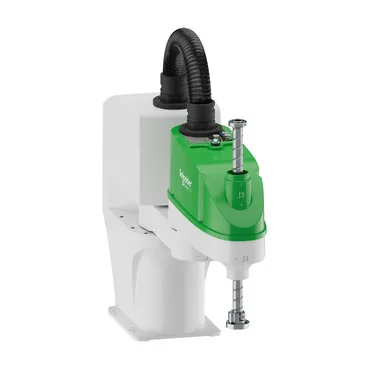
What LXMRSP0650200 actually is
The four axes give J1 ±130°, J2 ±129°, J3 200 mm, and J4 ±360°, with the whole arm rotating through a full 360° at the base — the kinematic envelope an integrator sizes the cell around (cites:,).
Throughput, accuracy, and where it actually fits on a line
Maximum actuation speed is 7050 mm/s on the J1+J2 horizontal axes and 1100 mm/s on J3, with a J4 angular speed of 2150°/s — the cycle-time ceiling on a pick-and-place or small-parts assembly station (cites:,). Repeatability sits at ±0.02 mm on J1 and J2, ±0.01 mm on J3, and ±0.01° on J4 — tight enough for screw-driving, dispensing, and small-connector insertion without an external fixturing camera (cites:).
Electrical envelope, EMC, and cabinet planning
Mains is 170…250 V AC full-performance, with a 100…170 V AC window that derates performance by 15% — the cabinet feed needs to be confirmed against the lowest expected steady-state line voltage, not just the nominal (cites:). Peak power draw is 2 kW with a rated continuous of 0.9 kW; the upstream breaker and contactor should be sized for the 2 kW surge at acceleration, not the steady figure (cites:,). EMC hardening is 4 kV ESD and 2 kV fast-transient, ambient 0…40 °C operating, with altitude derating kicking in above 1000 m (10% at 1500 m, 20% at 2000 m) — plan the cabinet layout around that thermal envelope rather than the bare IP20 rating (cites:,). Base protection is IP20; the listed IP65 figure is reached only with the conformity kit fitted, which is the option the cell-builder needs to spec separately if the robot sits in a washdown or splash zone (cites:).
Acoustic footprint and shop-floor reality
Noise level is rated at 70 dB — quiet enough that the cell does not need an acoustic enclosure for operator comfort, but loud enough to keep a hearing-protection note in the risk assessment when several units run side by side (cites:).