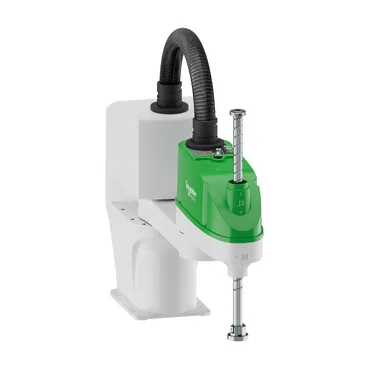
SCARA class, 600 mm reach, 6 kg payload
The LXMRSP0660300: For contract-manufacturing buyers, the part is a single SKU under one part number — no configurator split between reach and Z-stroke is on the face of the listing, so the AVL/AML cross-check happens against this exact code rather than a variant family.
Workspace envelope and repeatability
Joint envelope is J1 ±130°, J2 ±148°, J3 300 mm vertical stroke, and J4 ±360° rotational — the working cube sweeps a 600 mm horizontal radius and 300 mm vertical travel. Maximum actuation speed is 7750 mm/s on the J1+J2 horizontal pair and 1100 mm/s on the J3 vertical, with J4 topping out at 2150 °/s. Repeatability is ±0.02 mm on J1 and J2 and ±0.01° on J4 — tight enough for screw-driving and small-connector insertion, not precision-machining tolerance work.
Supply, EMC, and altitude derating
Input is single-phase 170…250 V AC at full rating, with a 100…170 V AC low-line window that derates performance by 15%. Above 1000 m altitude the robot derates 10% per 1000 m, capped at 2000 m where the performance budget drops 20% — a customer site above that needs an active cooling review, not just a nameplate check. EMC resilience is 2 kV on fast transients and 4 kV electrostatic discharge per the immunity profile. Ingress is IP20 as shipped, upgrading to IP65 with the conformity kit installed — the kit is the line between a dry-room cell and a washdown-adjacent station. Operating ambient is 0…40 °C; storage and transport span −20…60 °C. The acoustic footprint is 70 dB, so cell layout planning needs to budget for enclosure attenuation if the station sits next to an operator workstation without PPE.
Sourcing posture for the BOM line
Lifecycle is current and active per the manufacturer's record. For buyers who can dual-source, the procurement question is supply continuity on this exact code rather than a drop-in second source.