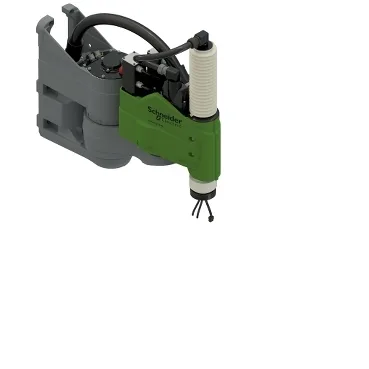
Speed and repeatability — what the numbers buy on the line
The LXMSTS40W300000: Repeatability is +/-0.01 mm, which is the figure that decides whether the cell is assembly-grade or transfer-only — at that tolerance the arm is in the same conversation as SCARAs used for screw-driving, dispensing, and small-parts placement rather than just conveyor handoffs. Nominal linear speeds land at 2000 mm/s on axis 3 and 4.92 m/s on axes 1 and 2, with maximum actuation speeds of 2220 mm/s on axis 3 and 6.91 m/s on axes 1 and 2; angular speed runs 450°/s nominal on axis 1 (650°/s max) and 600°/s nominal on axis 2 (800°/s max), with axis 4 reaching 1200°/s nominal and 1929°/s max, so the wrist and the horizontal axes are not paced by the same drive budget.
Sourcing reality — status on record
The lifecycle record lists this catalog entry as obsolete, which is the dominant procurement signal: a buyer placing the LXMSTS40W300000 on a BOM today is buying into a discontinued SKU rather than a running line, and the only honest channel is independent supply with lot-specific quantities confirmed at RFQ. One separate specification field carries a value of 'current', which sits alongside the obsolete status rather than replacing it — the two records are not reconciled here, so the obsolete reading governs and the 'current' tag is treated as a legacy data point rather than a production confirmation.
Integration context — normal-environment cell
Environmental characteristic is listed as 'Normal environment', which sets the cell expectation — an interior factory floor with controlled humidity and dust load, not washdown or outdoor duty, so the bellow cover on the vertical axis is the contamination guard the seller expects the user to rely on. Packaging is one unit per package, and the rotational 360° operating position is the mounting convention an installer wires the cell around — a fixed-orientation fixture planning around the arm envelope rather than the reverse.