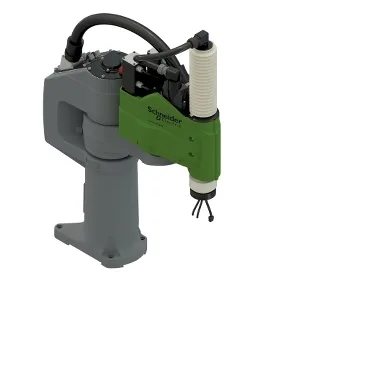
What shows up at the receiving dock
The Schneider Electric LXMSTS40F300000 is a PacDrive 3 STS40 SCARA robot — a floor-mount 4-axis pick-and-place arm, not a standalone servo drive — configured with ball screw 200 mm Z-axis drive, bellows 200 protection, and a user I/O cable harness as shipped.
Speed envelope across the four axes
Axis 1 runs 450°/s nominal, 650°/s maximum; axis 2 runs 600°/s nominal, 800°/s maximum — the nominal figures are the steady-state cycle rates the arm sustains in a working pattern, while the maximum figures are the burst peaks the controller will command during fast-position moves between points. Axis 4 (the wrist rotation) is the fastest joint, rated 1200°/s nominal and 1929°/s maximum, which is the figure that gates pick-and-place cycle time on small-geometry parts. On the linear axes, nominal linear speed is 2000 mm/s on axis 3 (Z) and 4.92 m/s on axes 1 and 2, with maximum actuation speed reaching 6.91 m/s on axes 1 and 2 — the delta between nominal and maximum is where the motion planner trades cycle time against vibration and payload stability. Horizontal operating travel is 0 to 800 mm and vertical 0 to 200 mm, defining the working envelope the cell layout has to clear.
Reading the lifecycle flags correctly
The LXMSTS40F300000 is flagged Obsolete, so the standard Schneider Electric channel is closed; the spec sheet itself still carries a current lifecycle stage tag, which is the editorial state of the datasheet entry and not a fresh-production claim — treat the obsolete flag as authoritative for sourcing.
Procurement posture for a discontinued SCARA
The packaging quantity is one unit per pack, so spares are bought singly rather than in case multiples — relevant for a line-down MRO call where only one arm is needed to restore a cell.