What actually ships under this code
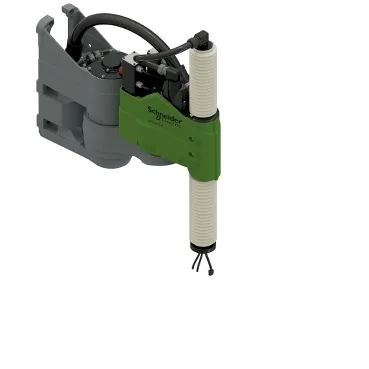
LXMSTS40W500000 is a Schneider Electric STS40 SCARA robot inside the PacDrive 3 motion platform — a 4-axis mechatronic assembly, not a standalone servo drive. The configured kit ships with a ball-screw Z-axis to 400 mm, a 400 mm bellow, and a user I/O cable, all in a single unit-of-sale package.
Kinematic envelope and what the numbers mean on the line
Repeatability is ±0.01 mm across the workspace, which is the spec that decides whether this class of arm fits a pick-and-place or small-parts-assembly cell rather than a high-throughput palletizing job. Horizontal operating travel reaches 800 mm on axis 3 with 2000 mm/s nominal speed and up to 2220 mm/s actuation; vertical travel tops out at 400 mm. Axis 1 nominal/maximum angular speed is 450°/s and 650°/s respectively; axis 2 runs 600°/s nominal, 800°/s maximum; axis 4 reaches 1200°/s nominal and 1929°/s maximum — useful when sizing cycle time against the slowest axis in the move profile.
Lifecycle read and what it changes in the BOM
For a line already running STS40 arms, that means replacement units, if needed for a line-down event, move through independent distribution on a per-RFQ basis — lot quantity, traceability paperwork, and pricing are all confirmed at quote time.
Integration notes for the controls cabinet
The robot mounts in any rotational orientation through 360° and rides on the PacDrive 3 controller family — pair it with the matching PacDrive LXM drive module and confirm the user I/O cable is landed to the controller's dedicated I/O port before commissioning.