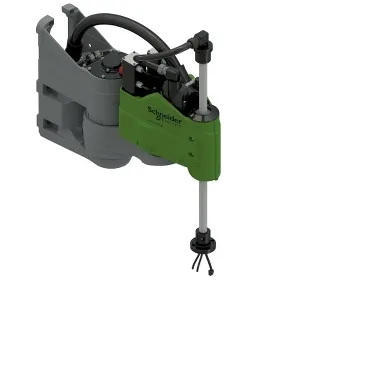
Four-axis SCARA, sized for 8 kg on the wall
The LXMSTS40W400000: Repeatability is +/- 0.01 mm — the figure that actually decides whether the cell is a pick-and-place workhorse or a precision assembly candidate. For a ball-screw driven arm at this payload class, that tolerance is consistent with dispensing, screw-driving, and small-parts kitting rather than high-force machining.
Axis-by-axis motion envelope
Axis 1 and axis 2 run 450°/s nominal and 650°/s maximum on axis 1, 600°/s nominal and 800°/s maximum on axis 2, with a 4.92 m/s nominal linear speed on both. Axis 3 reaches 2000 mm/s nominal and a maximum actuation speed of 2220 mm/s — that is the vertical/Z stroke and dictates the cycle-time floor for top-loading moves. Axis 4 — the wrist rotation — runs 1200°/s nominal and 1929°/s maximum, fast enough to keep orientation changes from dominating the cycle. Maximum actuation speed on axes 1 and 2 is 6.91 m/s, useful when sizing the PacDrive 3 controller's trajectory planner and the safety-rated reduced-speed parameters around the cell.
Listed as obsolete — what that does to sourcing
Schneider Electric lists the LXMSTS40W400000 as obsolete, which means new-from-factory stock through the OEM channel has wound down. For an installed PacDrive 3 line where the arm is the only robot variant that fits the cell envelope, the realistic path is independent distribution sourcing to order against an RFQ — lot size, condition, and trace confirmed at quote time. The lifecycle entry carries no official successor order code, so any 'replacement' claim needs to be qualified — a different STS variant may share the PacDrive 3 controller but not the reach or payload envelope. Buyers chasing a true cross-reference should compare ball-screw length, reach (400), and the user I/O cable variant before specifying.