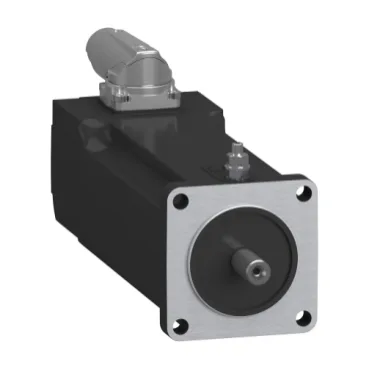
What the SH3 55 mm frame actually delivers at the shaft
The SH30552P0BA4100: Nominal torque lands at 0.75 N.m on single-phase 230 V and drops to 0.63 N.m on the three-phase 400 V and 480 V rails; peak stall torque is 2.5 N.m with a 4.8 A Irms ceiling, so the motor has roughly 3.3× torque headroom for acceleration and impact loads before the drive current-limits.
Encoder, brake, and shaft — the configuration this code commits you to
Encoder is an absolute multiturn Hiperface DSL on a single cable link, so position is retained through power cycles and only one hybrid connector runs from the motor back to the drive — fewer cables in the cable track than the older resolver-plus-encoder dual-cable schemes. Holding brake is listed as without — this code ships as a non-braked servo. Vertical-axis applications that need a fail-safe holding torque must add an external mechanical brake or specify the braked variant in the same frame.
Electrical envelope — constants the drive has to match
Back-EMF constant is 40 V/krpm at 20 °C and torque constant is 0.59 N.m/A at 120 °C — the drive's bus voltage and current loop have to be sized off these two numbers, not the headline wattage, because they set the no-load speed and the amps-per-N.m the controller actually commands. Stator resistance is 17.4 Ohm and inductance 18.2 mH; continuous stall current is 1.2 A and 3-second peak output current matches the 4.8 A Irms ceiling, so the servo drive must support the same 3-phase architecture and a current-loop bandwidth capable of the 3 s peak duty without I²T trip. Maximum mechanical speed is 9000 rpm and nominal speed reaches 8000 rpm at 400 V three-phase and 9000 rpm at 480 V three-phase, with a lower 4000 rpm ceiling on 230 V single-phase — the field-weakening range above base speed is short, so applications targeting sustained high-rpm duty need the 480 V supply.
Mounting, shaft loads, and what fits on the panel
Mounting is a 55 mm international-standard flange with four 5.5 mm holes on a 40 mm centring collar, 2 mm deep — a standard servo-footprint pattern that bolts directly to most gearhead and planetary input flanges in this size class. Maximum radial shaft load is 660 N at 1000 rpm and maximum axial load is 80 N — adequate for small pinions and direct-couple belt drives but a belt drive with significant overhung load needs the load point checked against the speed-squared derating curve before committing.