Supply voltage and the speed-torque envelope
The SH30552P01A2100: This SH3 frame servo motor delivers 530 W continuous power, but the speed and torque available depend on the supply you feed it. On three-phase 400 V or 480 V, it reaches 6000 rpm nominal speed and produces 0.63 N.m nominal torque. On single-phase 115 V, nominal speed drops to 2000 rpm with 0.77 N.m torque; on 230 V single-phase, 4000 rpm at 0.75 N.m. The continuous stall torque across three-phase supplies is 0.71 N.m at 1.2 A continuous stall current, with a peak stall torque of 2.5 N.m available for acceleration transients. The torque constant is 0.59 N.m/A at 120°C copper temperature, so the drive current loop scales linearly from the continuous stall current up to the 4.8 A peak.
Encoder, feedback, and mechanical interface
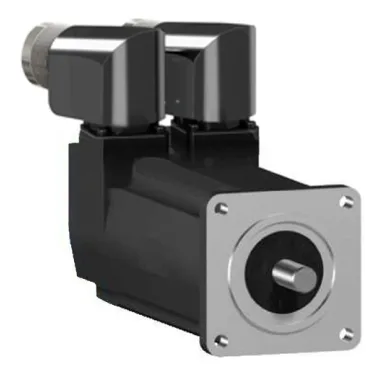
The absolute single-turn SinCos Hiperface encoder gives position feedback at standstill and through motion without a home cycle — the drive knows the rotor angle on power-up. The back EMF constant of 40 V/krpm at 20°C sets the voltage ceiling for the drive bus; at 6000 rpm the generated voltage reaches 240 V line-to-line, so a 400 V-class drive has headroom. The motor mounts on a 55 mm international standard flange with a 40 mm centring collar and 2 mm centring collar depth. The smooth shaft is 9 mm diameter, 20 mm long — no keyway, so the coupling or pulley must clamp on the shaft without a key. Maximum radial force at the shaft nose is 370 N at 1000 rpm, derating to 200 N at 6000 rpm; maximum axial force is 40 N. The electrical connection uses a rotatable right-angled connector — the cable exit angle adjusts in the field to clear adjacent hardware in a tight cabinet. IP65 rating on both the motor body and the shaft bushing means the motor withstands washdown and dust ingress per IEC 60034-5.
Lifecycle and sourcing for a project milestone
The stator inductance of 18.2 mH and resistance of 17.4 Ohm define the electrical time constant and the current-loop tuning range for the matching drive. The motor is naturally convection-cooled — no fan, so the thermal budget depends on the mounting surface and ambient air flow in the enclosure.