Speed-torque envelope across supply voltages
The SH30702M02A2200 delivers a nominal speed of 3000 rpm at 400 V three-phase supply, with a nominal torque of 2.03 N·m (17.97 lbf·in) at that operating point. At 480 V three-phase the same torque holds, and the speed ceiling rises to 3600 rpm. On single-phase 230 V the nominal speed drops to 1500 rpm with 2.15 N·m torque, and on 115 V single-phase it runs 750 rpm at 2.2 N·m. This voltage-dependent speed-torque curve means the motor's rated output power shifts from 660 W (400 V) to 780 W (480 V) and down to 340 W (230 V single-phase) — the actual usable power depends on the drive's input supply, not just the motor nameplate.
Encoder feedback and drive pairing
The motor carries an absolute multiturn SinCos Hiperface encoder. This is a digital-plus-analog feedback interface common on Schneider Lexium drives and third-party servo drives that support the Hiperface protocol. The multiturn absolute tracking means the drive knows the shaft position at power-up without a homing cycle — critical for applications where the axis position must be retained after a power loss. The SinCos analog track provides fine interpolation for velocity ripple control. Verify that the selected drive's encoder input supports Hiperface and the multiturn resolution before committing the BOM line.
Sealing and environmental fit
The motor body carries IP65 protection per IEC 60034-5, with the shaft bushing also rated IP65 and the housing IP67. The IP67 housing rating exceeds the shaft bushing rating, so the seal at the shaft exit is the wet-end limit; in continuous spray applications, orient the motor so the shaft seal is not directly impinged.
Mounting and shaft details
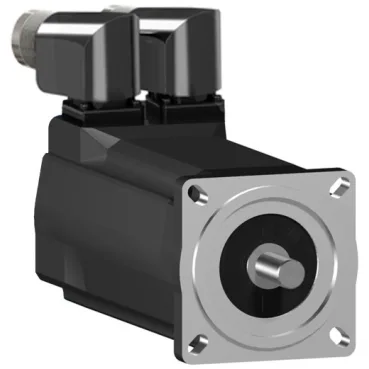
The motor flange is 70 mm (2.8 in) with a 60 mm centring collar and 5.5 mm mounting holes — this is the standard IEC 72-1 flange pattern for this frame size, compatible with most planetary gearboxes and machine-mount brackets. The shaft is smooth (no keyway) with an 11 mm diameter and 23 mm length. A clamping-type coupling or friction-lock hub is required; a keyed coupling will not engage. The maximum radial force at the shaft is 710 N at 1000 rpm, dropping to 390 N at 6000 rpm — this governs the allowable belt tension or overhung load from a direct-coupled pulley.
No holding brake — plan for vertical loads
This variant ships without a holding brake. For vertical-axis applications (Z-axis, elevators, gravity-loaded conveyors), an external brake or a brake-equipped motor variant must be specified to prevent the load from dropping when the drive is disabled. The motor's own detent torque and the drive's holding current are not sufficient for safety-rated load holding. If the application requires a brake, order the equivalent SH3 motor with the brake option — the frame size and encoder are the same, so the mechanical integration does not change.