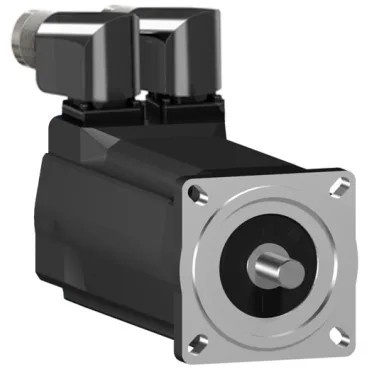
Speed range: 750–3600 rpm depending on supply
The SH30702M02F2000: This motor's nominal speed shifts with the input voltage — 750 rpm on 115 V single-phase, 1500 rpm on 230 V single-phase, 3000 rpm on 400 V three-phase, and 3600 rpm on 480 V three-phase. That means the same part number covers different line voltages, but the torque and power you get out changes. If your line is 400 V three-phase, you're looking at 660 W nominal output power at 3000 rpm; on 480 V three-phase that climbs to 780 W at 3600 rpm. The continuous power rating is 640 W — that's the thermal limit the motor can sustain with natural convection cooling, no external fan needed.
Torque numbers that matter for sizing
Holding torque is 3 N·m — that's the brake's rated static torque, enough to keep a vertical load from dropping when power is removed. Nominal torque depends on supply: 2.2 N·m at 115 V single-phase, 2.15 N·m at 230 V single-phase, 2.03 N·m at both 400 V and 480 V three-phase. Peak stall torque is 7.6 N·m across the three-phase range — that's the short-term overload capability for acceleration or overcoming friction. Continuous stall torque sits at 2.04 N·m, which tells you the motor can hold that torque indefinitely without overheating.
Encoder and feedback — what the Hiperface means
The encoder is an absolute multiturn SinCos Hiperface type. That's a sine-cosine encoder with a serial communication channel for absolute position — it tells the drive the exact rotor position on power-up, no homing sequence needed. Multiturn means it tracks more than one revolution, so it remembers position even if the machine moves while powered off. This encoder type pairs with Schneider's Lexium drives and many third-party servo drives that support the Hiperface protocol. The motor has 3 poles, so the electrical cycle matches the mechanical rotation at a 3:2 ratio.
Mounting, cooling, and environmental fit
The flange is the international standard 70 mm size with a 60 mm centring collar and 2.5 mm collar depth. Four mounting holes at 5.5 mm diameter on a standard bolt circle. The shaft is 11 mm diameter, 23 mm long, smooth (no keyway) — that means you need a clamping-type coupling or a set-screw hub that grips the smooth surface. Cooling is natural convection, so no fan or forced air required — keep the motor body clear for airflow. IP rating depends on the shaft seal: IP54 without the shaft seal ring, IP65 with it. For washdown environments, spec the sealed version; for dry cabinet mounting, the IP54 is fine.
Electrical connections and wiring
The motor comes with a straight connector as standard, and a rotatable right-angle connector is also available — useful when cable clearance is tight in the panel or machine frame. Maximum current is 6 A RMS, continuous stall current is 1.5 A. Stator resistance is 16.4 ohms, inductance is 115.7 mH — these numbers matter for the drive's tuning parameters and current-loop bandwidth. The torque constant is 1.36 N·m/A at 120 °C copper temperature, and the back EMF constant is 95.9 V/krpm at 20 °C. Maximum mechanical speed is 8000 rpm — don't overspeed beyond that, the rotor can't take it.