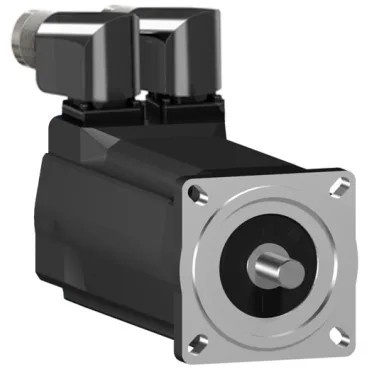
The SH30702M02F2200 is a 640 W three-phase servo motor with an integrated holding brake — the brake holds 3 N.m (26.6 lbf.in) static, so vertical-axis loads stay put when the drive removes power; no external brake resistor needed. Nominal speed depends entirely on what voltage you feed it: 750 rpm at 115 V single-phase, 1500 rpm at 230 V single-phase, 3000 rpm at 400 V three-phase, or 3600 rpm at 480 V three-phase. If your line runs 400 V three-phase, budget for 3000 rpm rated speed — the motor doesn't pick one; the drive input sets it. Same story with nominal torque: 2.2 N.m at 115 V single-phase, 2.03 N.m at 400/480 V three-phase. Peak stall torque across the three-phase range is 7.6 N.m — that's the short-term grunt for acceleration or overcoming a jam before the drive current limit clips it. The absolute multiturn SinCos Hiperface encoder means no homing sequence on power-up — the motor knows its position through a power cycle. That saves a minute per axis on every startup; in a multi-axis line that adds up fast.
Mounting and environmental fit
Motor flange size is 70 mm (2.8 in) international standard flange — bolts to a standard 70 mm face; centring collar is 60 mm diameter, 2.5 mm deep. Four mounting holes at 5.5 mm diameter on the bolt circle. Shaft is 11 mm diameter, 23 mm long, smooth (no keyway). Key width on the flat is 4 mm. Maximum radial force at the shaft nose is 710 N at 1000 rpm, dropping to 390 N at 6000 rpm — keep belt tension or direct-coupling loads within that envelope. IP65 on the motor body and shaft bushing, IP67 on the housing — this motor takes washdown. If your line sees hose spray (food, beverage, wash-down zones), the IP67 housing seal handles it; the shaft bushing is the weaker link at IP65, so avoid direct jet spray at the shaft exit. Cooling is natural convection — no fan. That means the 640 W continuous rating assumes free air around the housing; if it's boxed in or mounted to a hot surface, derate or add forced air.
Sourcing and lifecycle — active, quoted to order
Sourced through independent distribution against an RFQ. The encoder type (Hiperface) and brake voltage should match your drive's feedback and brake output; confirm those at order.