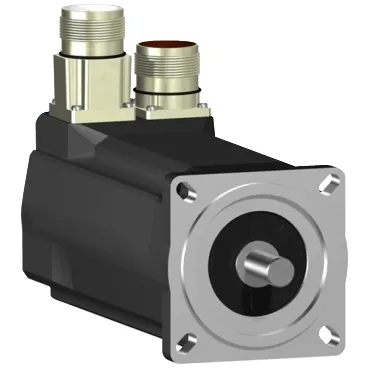
Three-phase servo with integrated holding brake
The SH30702M11F1000 is a three-phase servo motor from Schneider Electric's SH3 series, delivering 640 W continuous power and 2.03 N.m nominal torque at 400 V three-phase supply. The integrated holding brake provides 3 N.m holding torque, making it a natural fit for vertical-axis loads where the load must stay put when power is removed. Nominal speed reaches 3000 rpm at 400 V three-phase, with a maximum mechanical speed of 8000 rpm — the motor has headroom for short-term overspeed moves. The absolute single-turn SinCos Hiperface encoder gives the drive position feedback at power-up without a homing sequence, saving cycle time on every restart.
Torque and thermal envelope across supply voltages
Nominal torque varies with the supply: 2.2 N.m at 115 V single-phase, 2.15 N.m at 230 V single-phase, and 2.03 N.m at both 400 V and 480 V three-phase. The continuous stall torque is 2.04 N.m across the three-phase range, with a continuous stall current of 1.5 A — the motor runs cool at rated load with natural convection cooling. Peak stall torque reaches 7.6 N.m at 115–480 V three-phase, giving a 3.7× overload capability for acceleration and deceleration. The torque constant is 1.36 N.m/A at 120 °C copper temperature, so the drive current loop scales linearly with commanded torque up to the 6 A maximum current limit.
Mounting, sealing, and mechanical interface
The motor uses an international standard flange with a 70 mm flange size and 60 mm centring collar. The shaft is 11 mm diameter with a parallel key, 23 mm shaft length, and 4 mm key width — standard for coupling to ball screws or timing-belt pulleys in this power class. IP protection is IP54 on the shaft bushing without the shaft seal ring, and IP65 on the motor body and with the shaft seal ring fitted. For washdown or wet environments, specify the shaft seal ring to keep coolant and chips out of the bearing cavity. The electrical connection uses a rotatable right-angled connector or straight connector — the installer can orient the cable exit to fit tight enclosure clearances.