Motor sizing and supply-voltage dependency
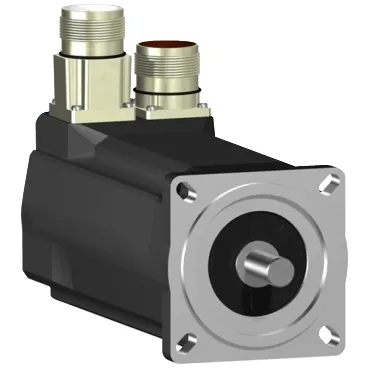
The SH30702M11F1100 is a three-phase servo motor from the SH3 series, delivering 640 W continuous power with a nominal torque that shifts with the supply: 2.2 N.m at 115 V single phase, 2.15 N.m at 230 V single phase, and 2.03 N.m at both 400 V and 480 V three phase. Nominal speed also depends on the line: 750 rpm at 115 V single phase, 1500 rpm at 230 V single phase, 3000 rpm at 400 V three phase, and 3600 rpm at 480 V three phase. The maximum mechanical speed is 8000 rpm, providing headroom for transient overshoots. The continuous stall torque is 2.04 N.m across the 115–480 V three-phase range, while peak stall torque reaches 7.6 N.m — this gap defines the acceleration capability for short-duration moves.
Encoder, brake, and environmental sealing
An absolute single-turn SinCos Hiperface encoder eliminates the need for a homing cycle on power-up — the motor knows its position immediately after the drive powers up, which cuts commissioning time on multi-axis machines. The holding brake delivers 3 N.m of holding torque, enough to lock a vertical axis against gravity when the drive is disabled. The brake is factory-fitted and wired through the motor connector.
Electrical parameters and drive tuning
The torque constant is 1.36 N.m/A at 120 °C copper temperature, and the back-EMF constant is 95.9 V/krpm at 20 °C. These are the numbers the drive uses to calculate the current command for a given torque demand. Continuous stall current is 1.5 A, with a maximum RMS current of 6 A — the drive's current rating must cover the peak demand during acceleration, not just the continuous figure.
Mechanical interface and mounting
The motor uses an international standard flange with a 70 mm flange size and a 60 mm centring collar. The shaft is 11 mm diameter with a parallel key, 23 mm shaft length, and a 4 mm key width — standard for this power class. Overall length is 212.5 mm. The electrical connection is available as either a rotatable right-angled connector or a straight connector, giving flexibility in cable routing within a tight cabinet. Maximum radial force is 710 N at 1000 rpm, derating to 390 N at 6000 rpm. Maximum axial force is 80 N. These limits govern the allowable belt tension or direct-coupling misalignment.