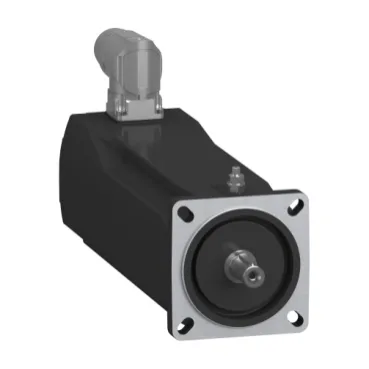
Sizing the SH30702P1AF4000 for the load and drive
The nominal torque sits at 1.8 N.m on three-phase supplies and 2.1 N.m on single-phase, so the load torque at continuous speed must stay below these figures to avoid thermal overload. Peak stall torque reaches 7.6 N.m across the 115...480 V three-phase range — this is the short-term ceiling for acceleration and deceleration moves, not a continuous rating. The continuous stall torque is 2.04 N.m, which is the torque the motor can hold at zero speed indefinitely without overheating. Nominal speed depends on the supply voltage: 3000 rpm on 230 V single-phase, 6000 rpm on 400 V three-phase, and 7200 rpm on 480 V three-phase. The drive's bus voltage and the motor's back EMF constant of 48 V/krpm at 20 °C set the practical top speed — if the back EMF approaches the bus voltage, the current loop loses headroom and torque drops off.
Brake, feedback, and mechanical interface
An integrated holding brake delivers 3 N.m holding torque, making this motor suited for vertical-axis applications where the load must stay put when power is removed. The brake pull-in power is 7 W — the drive's brake control output must supply this to release the brake. The motor flange is 70 mm with a centring collar depth of 2.5 mm, and the shaft is 11 mm diameter with a 23 mm length and a parallel key (key width 4 mm) — these dimensions define the coupling or pulley interface and the mounting pilot register.
Environmental protection and cooling
The motor body carries IP65 protection per IEC 60034-5, meaning it is dust-tight and protected against low-pressure water jets — suitable for washdown environments. The shaft bushing without a shaft seal ring drops to IP54, so the shaft exit point is splash-proof but not jet-proof. Cooling is by natural convection — no fan or liquid circuit required, but the motor must be mounted with free air movement around the housing to dissipate the 1130 W of continuous losses. The maximum winding temperature is 130 °C (copper hot), and the drive's thermal model should protect the motor to this limit. Maximum radial force is 990 N at 1000 rpm, and maximum axial force is 160 N — these bearing load limits must be respected when using belt drives or direct couplings; radial force derates with speed.
Electrical parameters and drive compatibility
Stator resistance is 4.2 Ohm and stator inductance is 10.65 mH — these set the electrical time constant and influence the drive's current ripple and PWM frequency selection. The torque constant is 0.7 N.m/A at 120 °C, which the drive's current loop uses to map the torque command to the current reference. Maximum continuous current (Irms) is 11.8 A, and the output current 3 s peak is also 11.8 A — the drive must be sized to supply this current continuously and for short-term overloads. The electrical connection is a rotatable right-angled connector with QuickLock, simplifying cable routing in tight cabinets.