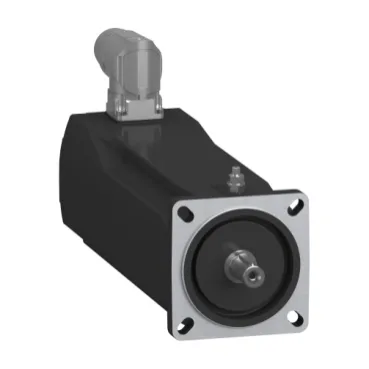
Speed and torque depend on your supply voltage
The SH30702P1AF4100: This motor delivers 3000 rpm on 230 V single-phase input, 6000 rpm on 400 V three-phase, and 7200 rpm on 480 V three-phase. The nominal torque drops from 2.1 N.m at 230 V to 1.8 N.m at 400/480 V — the winding is optimized for the higher voltage range, so the torque-per-amp is lower on three-phase. Continuous power is 1130 W on three-phase supplies; on 230 V single-phase it's 610 W. If your line runs 230 V single-phase, budget for the reduced power ceiling.
Brake is for holding, not stopping
The holding brake delivers 3 N.m static torque — it locks the rotor when power is removed, preventing a vertical load from dropping. It is not rated for dynamic braking; use the drive's regenerative braking or an external resistor for deceleration. Brake pull-in power is 7 W, typically supplied by a 24 VDC auxiliary supply.
Encoder choice saves a homing cycle
The absolute single-turn Hiperface DSL encoder reports position on power-up — no homing or reference run needed after a power cycle. This cuts commissioning time on multi-axis machines and eliminates the home sensor wiring.
IP65 lets it handle washdown
Both the motor body and the shaft bushing are rated IP65 per IEC 60034-5. The connector seal must be properly mated to maintain the rating.
Thermal limits and current draw
Maximum continuous current is 11.8 A, and the same value applies for the 3-second peak output — the drive must be sized to deliver this peak without tripping. The torque constant is 0.7 N.m/A at 120 °C copper temperature; at room temperature it will be slightly higher, but use the hot value for thermal sizing. Stator resistance is 4.2 Ohm and inductance is 10.65 mH, giving an electrical time constant around 2.5 ms. The drive's current loop gains should be tuned to this time constant for stable torque control.
Mechanical fit and shaft loading
The motor mounts on a 70 mm international standard flange. Overall length is 213 mm, shaft diameter 11 mm with a 23 mm shaft length and 4 mm key width. Centring collar depth is 2.5 mm — confirm the mating pilot bore depth. Maximum radial force is 990 N at 1000 rpm; maximum axial force is 160 N. These are bearing life limits — belt tension or gear thrust loads must stay within these values at the operating speed.