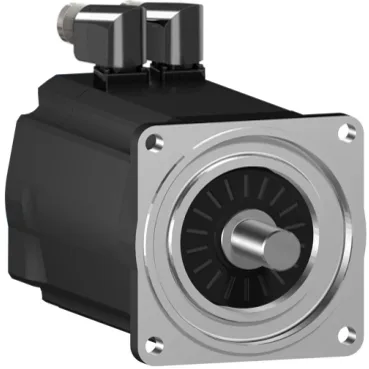
SH31002M12A2000 — what this SH3 servo delivers
This is a Schneider Electric SH3 series servo motor, sizing reference SH31002M, built for three-phase supply. It delivers 1100 W continuous power and 5.8 N.m continuous stall torque across a 115...480 V three-phase range, with a peak stall torque of 18.3 N.m for short-duration acceleration moves. The motor is fitted with an absolute multiturn SinCos Hiperface encoder — the type that remembers position through a power cycle, so you skip the homing sequence on restart. No holding brake on this variant, so the load must self-hold or you add an external brake.
Speed and torque across supply voltages
Nominal speed shifts with the line voltage: 500 rpm on 115 V single phase, 1000 rpm on 230 V single phase, 2000 rpm on 400 V three phase, and 2400 rpm on 480 V three phase. Nominal torque sits at 5.62 N.m on 115 V single phase and drops slightly to 5.28 N.m on 400 V or 480 V three phase — the torque curve is nearly flat across the voltage range. Nominal output power follows the same pattern: 300 W on 115 V single phase, 580 W on 230 V single phase, 1090 W on 400 V three phase, and 1280 W on 480 V three phase. The 1100 W continuous power rating is the figure for three-phase operation at nominal load.
Mounting, cooling, and environmental sealing
Mounts on an international standard flange with a 100 mm flange size and 95 mm centring collar. The shaft is 19 mm diameter with a parallel key, 40 mm shaft length. Four mounting holes at 9.0 mm diameter on a 3.9 in (100 mm) bolt circle — standard bolt pattern for this frame size. Cooling is natural convection — no fan, so you need to account for the thermal rise in the enclosure. IP rating is IP54 at the shaft bushing without the shaft seal ring, and IP65 on the motor body and shaft bushing when the seal ring is fitted. That means it handles washdown spray but not submersion. The electrical connection uses a rotatable right-angled connector — you can orient the cable exit to fit tight panel layouts without adding a right-angle adapter. Maximum radial force at the shaft is 990 N at 1000 rpm, derating to 620 N at 4000 rpm.