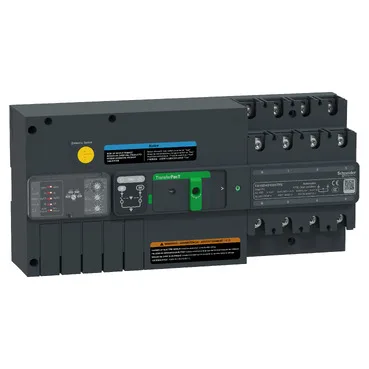
It is designed for PC-class changeover between two power sources, meaning it can break and make currents up to its rated value but is not intended for frequent switching under load — that is the AC-33B utilization category in practice: switching motor loads plus resistive and mixed loads, with occasional inrush. The 100 A conventional free-air thermal current (Ith) at 60 °C and the 10 kA short-time withstand (Icw) for 0.1 s tell you this switch can handle sustained load at its rating and survive a fault long enough for an upstream breaker to clear it. The 154 kA making capacity with an upstream breaker means it can close onto a fault without welding contacts — a critical spec for coordination studies.
The 351 mm width and 164 mm height mean it occupies a full-width slot in a standard 600 mm enclosure; plan for gland-plate space around the screwed top and bottom connections. The mechanical interlocking between source positions is built in — no risk of paralleling sources during transfer.