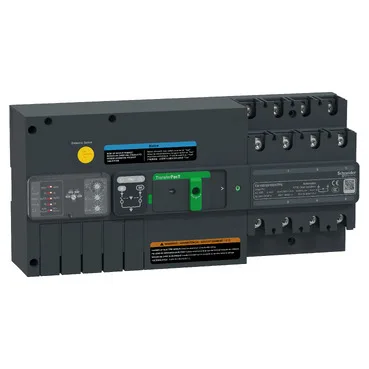
It is rated 160 A continuous (Ith 160 A at 60 °C) across three poles (3P), with a PC-class construction per IEC 60947-6-1, meaning it is a purpose-built transfer switch, not a modified contactor assembly. The AC-33B utilization category covers mixed loads including motors, resistive, and lighting — the common mix in commercial and light industrial standby power panels. The switch is rated for uninterrupted duty, so it can carry the full 160 A continuously without derating for cycling.
The 10 kA short-time withstand (Icw) for 0.1 s tells you the switch can ride through a fault until the upstream breaker clears — it is not a circuit breaker itself, but it coordinates with one. Without the breaker, the switch alone makes 20 kA. Impulse withstand (Uimp) is 8 kV for the switch and 6 kV for the controller, which covers most installation categories (overvoltage cat III). The front face carries IP40 in auto mode; inside the enclosure it is IP20, so the enclosure itself must provide the environmental seal.
The 351 mm width and 164 mm height mean it occupies a full-width slot in a standard distribution panel; the 95 mm depth leaves clearance for rear wiring. Connection pitch is 30 mm, and both upside and downside connections are screwed — expect to torque per the manufacturer's specification on the nameplate. Mechanical interlocking between the two sources is built in — the switch cannot close both sources simultaneously. A padlock provision in the OFF position allows lockout/tagout. The contact position indicator shows one of three positions: source 1, source 2, or OFF. Signal contacts are configurable: the composition options are 1 NO + 2 NC, 1 NC + 2 NO, or 2 NO — these provide status feedback to a PLC or building management system. The rotary knob selector switch allows manual override for testing or maintenance.