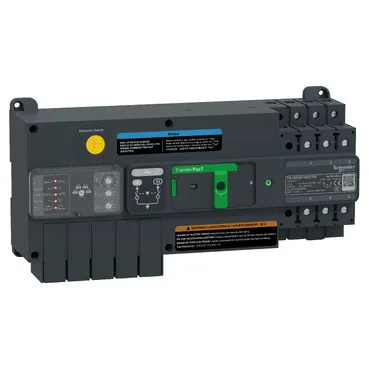
The Schneider Electric TA10D3S1004TPE is an automatic transfer switch from the TransferPacT range, rated 100 A continuous on a 400 V AC 50/60 Hz network. It is a PC-class switch per IEC 60947-6-1, meaning it is designed for full-rated current switching of the supply source without overcurrent protection built in — the upstream breaker handles fault clearing. The AC-32B utilization category confirms it is suited for mixed resistive and inductive loads including motors up to the rated current, under uninterrupted duty. The 5 kA short-time withstand for 0.1 s and a making capacity of 15 kA (switch alone) or 75 kA with an upstream breaker tell you the switch can close onto a fault and survive the let-through of a coordinated breaker.
The 310 mm width and 147 mm height mean it occupies a full-width slot in a standard 600 mm enclosure — plan the gland plate and busbar routing accordingly. The front face carries IP40 in auto mode, the interior enclosure side is IP20, so the switch itself is not sealed against washdown; it belongs in a dry cabinet. The screwed connections (top and bottom) accept standard lug terminations; verify lug width against the 18 mm pole pitch before terminating.
Key ratings and their meaning for fit
The 800 V rated insulation voltage on the switch side and 500 V on the controller side mean the switch can be used on 480 V systems (common in North America) as well as the listed 400 V, provided the controller supply stays within its 500 V limit. The 6 kV impulse withstand voltage on both sides confirms it handles transient overvoltages in industrial distribution without flashover. Mechanical interlocking between the two source positions is built in, preventing both sources from closing simultaneously — a requirement for any open-transition transfer switch. The padlockable OFF position and contact position indicator give the isolating function a verifiable air gap for lockout/tagout. The 8000-cycle mechanical durability is typical for a PC-class ATS — plan for replacement after roughly 20 years of weekly testing, or sooner under frequent transfer events.