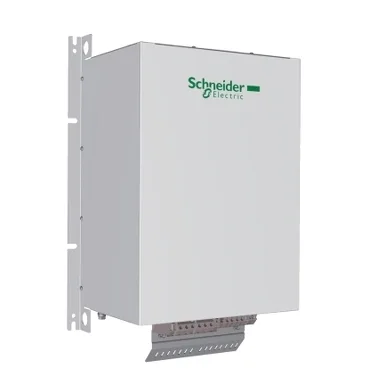
The Schneider Electric VW3A46106 is a passive filter designed to reduce current harmonics on the line side of Altivar variable speed drives. It is rated for 35 A input and 37 A output at 400 V +/-10%, 50 Hz +/-2%, and is a single-filter-per-drive solution for ATV61, ATV71, ATV630, ATV650, ATV930, and ATV950 series drives powering 18.5 kW / 25 hp motors.
The headline THDI figures — 10% for ATV61W, ATV630, ATV650, ATV930, ATV950; 16% for ATV61H, ATV71H, ATV71W — tell you the residual harmonic distortion after the filter, not the raw line distortion. A 10% THDI meets IEC 61000-3-12 and G5/4 engineering recommendation limits for most industrial installations; 16% still keeps you inside the Class 2 environment per IEC 61000-2-4. If your site requires below 8% THDI, this filter alone won't get you there — you'd need a tuned active filter or a multi-pulse drive front end. The power factor figures (cos φ = 1 at 150% line current, 0.99 at 100%, 0.85 at 75%) reflect the filter's effect on displacement power factor, not total power factor. At full load the filter keeps the drive looking nearly resistive to the supply, which avoids PF penalty charges on most utility tariffs. At light load (75% current) the 0.85 figure is still above the 0.80 threshold that triggers surcharges in many regions. Efficiency is listed at 98%, with 242 W thermal losses at rated load. That 242 W must be dissipated inside the enclosure — the filter runs warm. For a panel build, factor that heat into the ventilation or cooling budget; a sealed IP55 enclosure (the filter's own enclosure-mounted rating) will need forced airflow or a heat exchanger if other heat sources are present. The IP20 base rating applies when mounted inside a clean panel; IP55 only when enclosure-mounted per the manufacturer's instructions. Operating temperature range is 5 to 45 °C without derating, and 45 to 60 °C with a 3% per °C current derating. If the ambient inside your panel hits 50 °C, you must derate the filter's output current by 15% — meaning the 37 A output becomes effectively 31.5 A. That derating cascades into the drive's continuous motor current capability, so verify the combined thermal budget before committing the BOM line. Altitude derating begins above 1000 m: 5% per additional 1000 m. At 2000 m, the 37 A output derates to roughly 35.2 A. For installations in high-altitude regions (mining, Andean, Himalayan), this is the binding constraint, not the ambient temperature. Class F insulation (155 °C) on the filter windings provides margin for the thermal losses and the harmonic heating from the drive's PWM waveform. The filter is designed for continuous duty — the 1.5 x nominal current for 60 seconds rating covers motor starting inrush or short overload events, not sustained operation.
Deployment Context
This filter is a panel-mounted passive device, not a DIN-rail component. It connects via terminals: A/B terminals accepting up to 2.5 mm², and X1-1 through X2-3 terminals accepting 1.5 to 25 mm². The wiring is straightforward — line in, drive out — but the physical size and 242 W heat rejection mean it needs dedicated panel space with adequate airflow. Vibration resistance per IEC 60068-2-6 (2 mm peak-to-peak at 5-13.2 Hz, 0.7 gn at 13.2-150 Hz) is typical for industrial cabinet mounting; no special isolation required unless the panel is mounted on a high-vibration machine base.