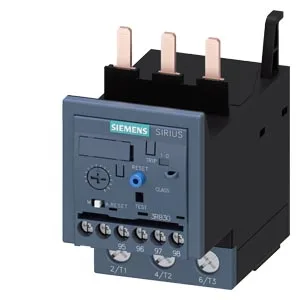
The Siemens SIRIUS 3RB3036-1UB0-ZW96 is a solid-state overload relay, Size S2, designed for motor protection in control panels. It mounts directly onto a contactor, saving panel space and simplifying wiring. Rated thermal current is 50 A at a rated insulation voltage of 690 V, so it handles a 50 A motor load continuously on a 400 V or 480 V line. The auxiliary switch is integrated, with a note for message 'tripped' — meaning the relay provides a dedicated signaling contact (97/98) that changes state when the overload trips, which you can wire into a PLC input or alarm lamp.
The trip class is Class 10E. This is the deciding factor for motor protection: it matches the thermal time constant of a standard squirrel-cage induction motor. If your motor starts against a high-inertia load that needs a longer acceleration time, a Class 20 or 30 relay would be needed instead. For most pump, fan, and conveyor drives, Class 10E is the correct choice. Thermal current is 50 A at both 480 V and 600 V rated value. This means the relay's continuous current rating does not derate across common North American line voltages — useful for a 480 V or 600 V motor branch circuit. The auxiliary switching capacity is listed per voltage: 2 A at 24 V, 4 A at 120 V, 3 A at 230 V. These are the make/break ratings for the trip-indication contact. If you are driving a 24 VDC PLC input, the 2 A rating is more than adequate — the contact is rated for the typical 10-20 mA sink current of a digital input.
Mounting and Wiring Integration
Fastening method is contactor mounting — this relay clips directly onto the front of a SIRIUS contactor, forming a compact motor starter assembly. No separate DIN-rail footprint is needed; the relay and contactor share the same mounting base. The main current circuit uses screw-type terminals accepting 1x 50 mm² or 2x 10-35 mm² stranded cable, sized for a 50 A motor feeder. Control wiring for the auxiliary contact uses smaller terminals: 1x 0.5-4 mm² or 2x 0.5-2.5 mm² solid or stranded. Mounting position is any, so the assembly can be oriented horizontally, vertically, or flat without affecting the trip curve. Shock resistance is 15g for 11 ms, vibration resistance per 1-6 Hz at 15 mm amplitude and 6-500 Hz at 20 m/s² — robust enough for machine-mounted applications near conveyors or presses.