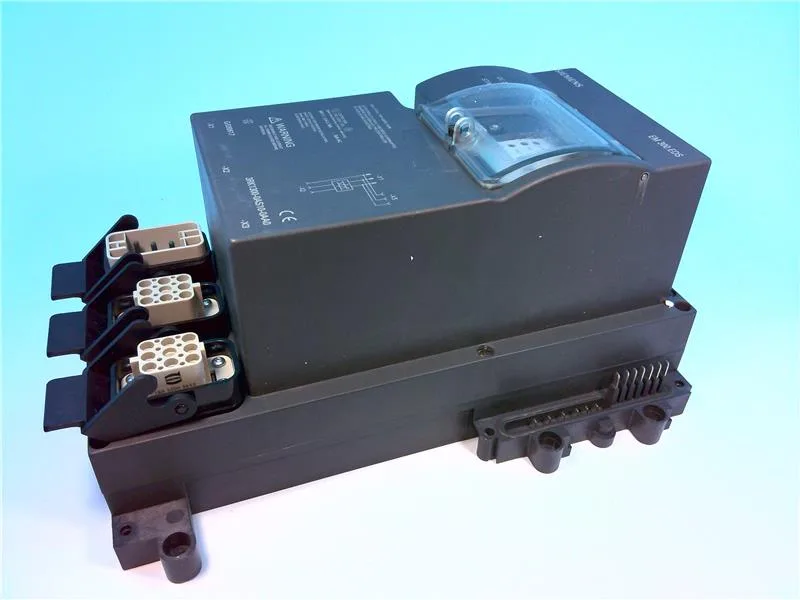
The Siemens 3RK1300-0AS10-0AA0 is an electronic direct starter from the SIRIUS family, designed for the ET 200X distributed I/O system. It provides solid-state motor protection and switching for three-phase motors up to 0.8 kW at 400 V AC-3 duty, with a setting range of 0.6 to 2.18 A. This is not a conventional electromechanical contactor with a separate overload relay — it's a single, solid-state device that integrates both the switching contact and motor protection into one compact package. The solid-state design means no moving contacts to wear out, but it also means the short-circuit protection must be provided by external fuses. Rated for 400 to 500 V DC supply voltage, it communicates over PROFIBUS DP, making it a fieldbus-connected motor starter suitable for distributed control architectures.
The AC-3 rating of 0.8 kW at 400 V is the motor-switching capability for standard squirrel-cage motors — that's the rating that governs real-world motor starting and stopping. The minimum motor rating of 0.18 kW at 400 V means it can also protect smaller motors without nuisance tripping. The setting range of 0.6 to 2.18 A covers the full-load current of the motor being protected. You dial in the motor's nameplate FLA within that window; the solid-state overload protection handles the rest. The minimum disconnection time of 1 second is the fastest the device can clear a fault — important to know for coordination with upstream protective devices. It's not submersible, but it handles hose-down cleaning common in food and beverage lines. The maximum short-circuit breaking capacity (Icu) at 400 V is 100 A. That's the fault current the device can safely interrupt when backed by the specified fuses.
The dimensions are 140 mm wide, 270 mm high, and 134 mm deep, so it occupies a significant footprint. The 9-pole power connection uses tab terminals, which means you need matching female quick-connect terminals on your motor and supply cables. The ambient temperature range during operation is 0 to 55 °C. If the enclosure sees higher internal temperatures — common in a sealed IP65 cabinet with multiple starters — you may need to derate or add forced ventilation.