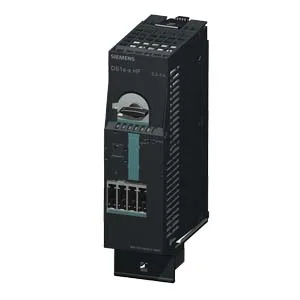
The 3RK1301-0CB13-0AA4 is a Siemens SIMATIC-branded motor starter — a direct starter that combines a contactor and overload relay into one module, designed for remote I/O and fieldbus environments. It integrates PROFINET and PROFIBUS DP protocols, so it talks directly to a PLC without a separate gateway, and the 2-byte input and 2-byte output data maps cleanly into a standard IO controller's process image. It is a direct starter only — no reversing capability — meaning it handles unidirectional motor loads like pumps, fans, and conveyors. The adjustable Trip Class 10 and 20 lets you match the thermal overload curve to the motor's starting profile: Class 10 for short acceleration times (e.g., centrifugal pumps), Class 20 for high-inertia loads that take longer to spin up.
Supply voltage and control power — what the 24 V DC rating means
The control supply is 24 V DC nominal, with a rated operating range of 21.6 to 26.4 V DC and permissible limits of 20.4 V minimum to 28.8 V maximum. That 20.4 V floor is important for brownout ride-through: if your 24 V bus sags under load, the starter stays latched down to that threshold. The 28.8 V ceiling protects against overvoltage from a poorly regulated power supply. The supply voltage 1 is also 24 V DC, confirming the module draws its logic power from the same rail as the motor contactor coil. No separate control transformer needed — just one 24 V DC bus feeding the entire starter.
Short-circuit rating and fault coordination
Rated 50 kA at 400 V for the main energy infeed — this is the SCCR (short-circuit current rating) that determines whether the starter can clear a fault without upstream breaker intervention. The pollution degree rating is 3 at 400 V and 2 at 500 V per IEC 60664 and IEC 61131, meaning the creepage distances are designed for conductive environments (e.g., dust or humidity) up to 400 V, but cleaner conditions at 500 V. This matters for panel placement — mount it away from contactor arcs or conductive debris paths.
Mounting, dimensions, and panel fit
The module fastens by plugging onto a terminal module — no screws, no DIN-rail clips. The dimensions are 65 mm wide, 290 mm high, and 150 mm deep, so it takes a vertical slice of panel height. Mounting position can be vertical or horizontal, giving flexibility in tight enclosures. The main energy infeed uses screw-type terminals — expect to torque 2.5–4 mm² conductors depending on the load current. The 2 digital inputs are wired via the control module; the module itself has no onboard digital outputs, so any feedback signals go through the fieldbus back to the PLC.
Reliability and operating limits
MTBF is listed at 14 years and MTTFd at 31 years — these are calculated values per Siemens reliability engineering, not field failure data. For a BOM freeze or maintenance planning, the MTTFd of 31 years supports a SIL-rated safety function if the rest of the loop meets the architecture constraints. Maximum operating frequency is 80 starts per hour — above that the thermal accumulation in the overload element may cause nuisance trips. The safe state is load circuit open, meaning on a fault or power loss the contactor drops out and the motor coasts to stop. Vibration resistance is 2g, shock resistance is 5g for 11 ms — adequate for most industrial machinery but not heavy-duty mobile equipment.
Lifecycle and sourcing — active production, quoted to order
Sourced through independent distribution channels and quoted to order against the BOM quantity.