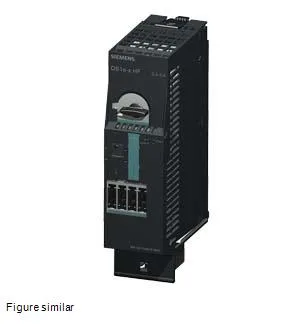
Siemens 3RK1301-0CB10-0AA3 — Remote I/O & Fieldbus Modules

Siemens SIMATIC 3RK1301-0CB10-0AA3 Motor Starter, PROFINET,

MPN3RK1301-0CB10-0AA3

Siemens SIMATIC motor starter, direct starter, 3RK1301-0CB10-0AA3, PROFINET, adjustable trip class 10 and 20, pluggable on terminal module.

Sourced new & surplus through independent channelsAuthenticity-screened · ESD-safe packingListing updated Jul 2026

Specifications

3RK1301-0CB10-0AA3 — Identification
ParameterValue
Product designationMotor starters
Product designdirect starter
3RK1301-0CB10-0AA3 — Communication
ParameterValue
PROFIBUS DP supportYes
PROFINET supportYes
AS-Interface supportNo
Bus communicationYes
3RK1301-0CB10-0AA3 — I/O
ParameterValue
Digital inputs2
Digital input signals0
Digital output signals0
Digital inputs parameterizableYes
Digital outputs parameterizableNo
3RK1301-0CB10-0AA3 — Electrical
ParameterValue
Rated value (DC)20.4 ... 28.8 V
Control supply voltage typeDC
Rated surge voltage6 kV
Adjustable Current Response Value Current Of The Current-Dependent Overload Release2.4 ... 16 A
Operating Voltage Rated Value200 ... 400 V
Number Of Poles For Main Current Circuit3
3RK1301-0CB10-0AA3 — Environmental
ParameterValue
Operating temperature range0 ... 60 °C
Storage temperature range-40 ... +70 °C
Shock resistance5g / 11 ms
Pollution degree3 at 400 V, 2 at 500 V according to IEC60664 (IEC61131)
3RK1301-0CB10-0AA3 — Mechanical
ParameterValue
Width65 mm
Depth150 mm
Height290 mm
Mounting methodpluggable on terminal module
3RK1301-0CB10-0AA3 — Specifications
ParameterValue
At 400 V rated value50 kA
Reverse StartingNo
Type Of The Motor Protectionsolid-state
Trip ClassCLASS 10 and 20 adjustable

Product details

The Siemens SIMATIC 3RK1301-0CB10-0AA3 is a direct motor starter designed for 24 V DC control supply, with a rated supply voltage range of 20.4 to 28.8 V DC. It integrates PROFINET and PROFIBUS DP protocols for fieldbus communication, making it suitable for automated motor control in distributed I/O architectures. Its adjustable trip class (CLASS 10 and 20) means you can set the overload protection curve to match the motor's starting characteristics — CLASS 10 for faster-starting loads like pumps, CLASS 20 for higher-inertia loads like conveyors or fans. This is a key selection parameter, not a fixed rating. The unit is pluggable onto a terminal module, so it mounts without hardwiring the power circuit — the energy bus handles main power transmission. This reduces panel wiring time and simplifies replacement: pull the old starter, plug in the new one.

Where you'd use this class of part

Motor starters like this one sit in control cabinets managing individual motor loads — conveyors, agitators, fans, pumps — in automated production lines. The SIMATIC branding places it within Siemens' integrated automation ecosystem, so it communicates directly with a SIMATIC PLC over PROFINET without a gateway. The 2-byte input and output assignments mean it reports status and accepts commands over the fieldbus in a compact data frame — typical for a motor starter in a PROFINET device network.

No last-time-buy or surplus-channel urgency applies here.

The depth of 150 mm and height of 290 mm with a 65 mm width define its panel footprint. It mounts vertically or horizontally, which helps when fitting into existing cabinet layouts — you are not locked into one orientation. That is a high interrupting rating, typical for industrial motor starters in high-fault-current installations.

Frequently asked questions

What fieldbus protocols does it support?

It supports both PROFINET and PROFIBUS DP protocols, giving flexibility for integration into Siemens or third-party automation networks.

What does adjustable trip class 10 and 20 mean for selection?

It means you set the overload protection curve to CLASS 10 for faster-starting motors (e.g., pumps) or CLASS 20 for higher-inertia loads (e.g., conveyors). This is not a fixed rating — you choose the protection characteristic that matches the motor's starting profile.

How does it mount in a panel?

It is pluggable onto a terminal module, so it snaps onto a DIN-rail-mounted base without hardwiring the power circuit. The main energy is transmitted via an energy bus, reducing wiring time.

What is its short-circuit breaking capacity?

It is rated 50 kA at 400 V, meaning it can safely interrupt a fault current up to that level without damage.

MPN
3RK1301-0CB10-0AA3