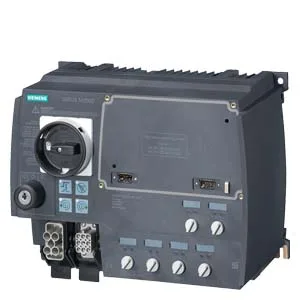
The Siemens 3RK1395-6KS41-3AD5-Z E09 is a SIRIUS M200D technology module configured as a reversing starter. It switches motor loads under AC-3 duty at 0.75 kW on a 400 V three-phase line, with the adjustable current range set between 0.15 A and 2.00 A. Electronic overload protection is onboard, and the module accepts THERMOCLICK or PTC thermistor inputs for motor temperature monitoring. The unit includes a brake contact rated for 180 V DC, plus 4 digital inputs and 2 digital outputs. Connectivity is via Han Q4/2 and Han Q8/0 mixed-power/data connectors, and the module communicates over PROFIBUS or PROFINET when paired with a 3RK1305* communication module. Manual on-site operation is provided, along with a key-operated switch (CES locking system) to prevent unauthorized access. This makes the starter suited for safety-guarded machinery where local lockout is required.
The AC-3 rating at 0.75 kW / 400 V defines the motor switching capability for squirrel-cage induction motors — the dominant load type in conveyors, pumps, and fans. The 0.15–2.00 A adjustment range means it covers small motors up to roughly 0.75 kW at 400 V; if your motor draws above 2.00 A full-load, this starter is undersized. Electronic overload protection with THERMOCLICK/PTC input means the module reads motor thermistor directly, tripping on overtemperature rather than relying solely on thermal replica curves. This is useful for motors in high-duty-cycle or frequent-start applications where I²t models lag. The 180 V DC brake contact handles DC injection brakes common on small reversing drives. The 4 DI / 2 DO count supports local start/stop, interlock, and status feedback without an extra I/O block.
The Han Q4/2 and Han Q8/0 connectors carry both power and fieldbus in a single hybrid cable, reducing wiring time compared to separate motor and network runs. Because it requires a 3RK1305* communication module for PROFIBUS or PROFINET, the system integrator must account for that additional component in the BOM. The key-operated CES lock satisfies machinery directive requirements for local isolation on safety circuits.