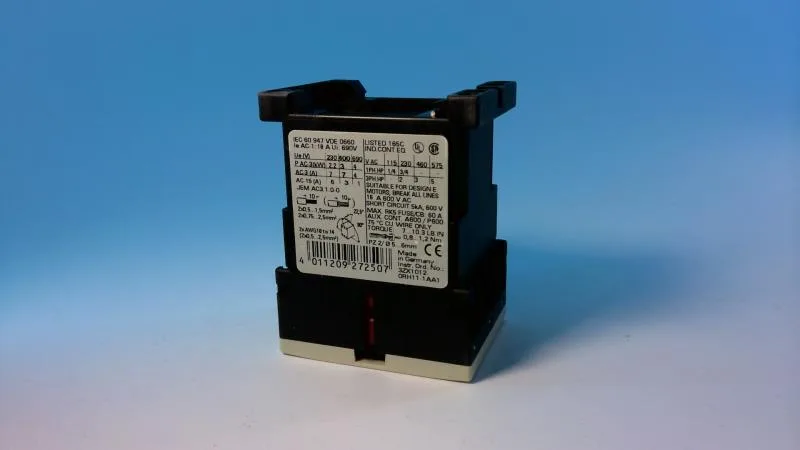
What It Is and Where It Fits
The Siemens 3RT1015-1AF01-ZW96 is a SIRIUS power contactor in the S00 frame size, designed for switching motor loads in control panels. It mounts via screw or snap-on onto a 35 mm DIN rail per EN 50022, making it a direct fit for standard industrial enclosures. At 45 mm wide, it occupies a single modular slot, so panel fill factor is predictable when laying out a multi-contactor group.
Key Ratings and What They Mean for Your Load
Rated for 3 kW at 400 V in AC-2 duty (slip-ring motor starting), this contactor handles the moderate inrush and longer acceleration times typical of wound-rotor motors. For AC-4 duty (plugging, inching, reversing), it carries 6.5 A at 400 V — the rating that governs the contactor's life under frequent switching. If your application involves reversing or jogging, the AC-4 figure is the one to size against, not the AC-2 number. The auxiliary contact block is rated 10 A at 24 V and derates to 0.3 A at 220 V — typical for a single-pole N.O. instantaneous contact. This is the contact you'd use for the PLC input or the holding circuit; the 10 A at 24 V gives headroom for multiple low-voltage loads in series.
Integration and Wiring
Screw-type terminals on the main circuit accept 2x (0.5 to 1.5 mm²), 2x (0.75 to 2.5 mm²), or a single 4 mm² conductor. For AWG, that's 2x (20 to 16), 2x (18 to 14), or 1x 12. The terminal box is rated IP20, so it's touch-safe once wired but not suitable for washdown environments. Side-by-side mounting is allowed with 6 mm spacing to the side — no derating penalty for ganging multiple contactors on the rail, which is typical for a multi-motor group in a single panel. For short-circuit protection, type 2 coordination (no damage to the contactor) requires a gL/gG fuse rated 20 A. Type 1 coordination (contactor may need replacement after fault) allows a 35 A fuse. The 20 A fuse is the safer bet for protecting the contactor in a critical-spare scenario — one in the cabinet, no surprises.
